 |
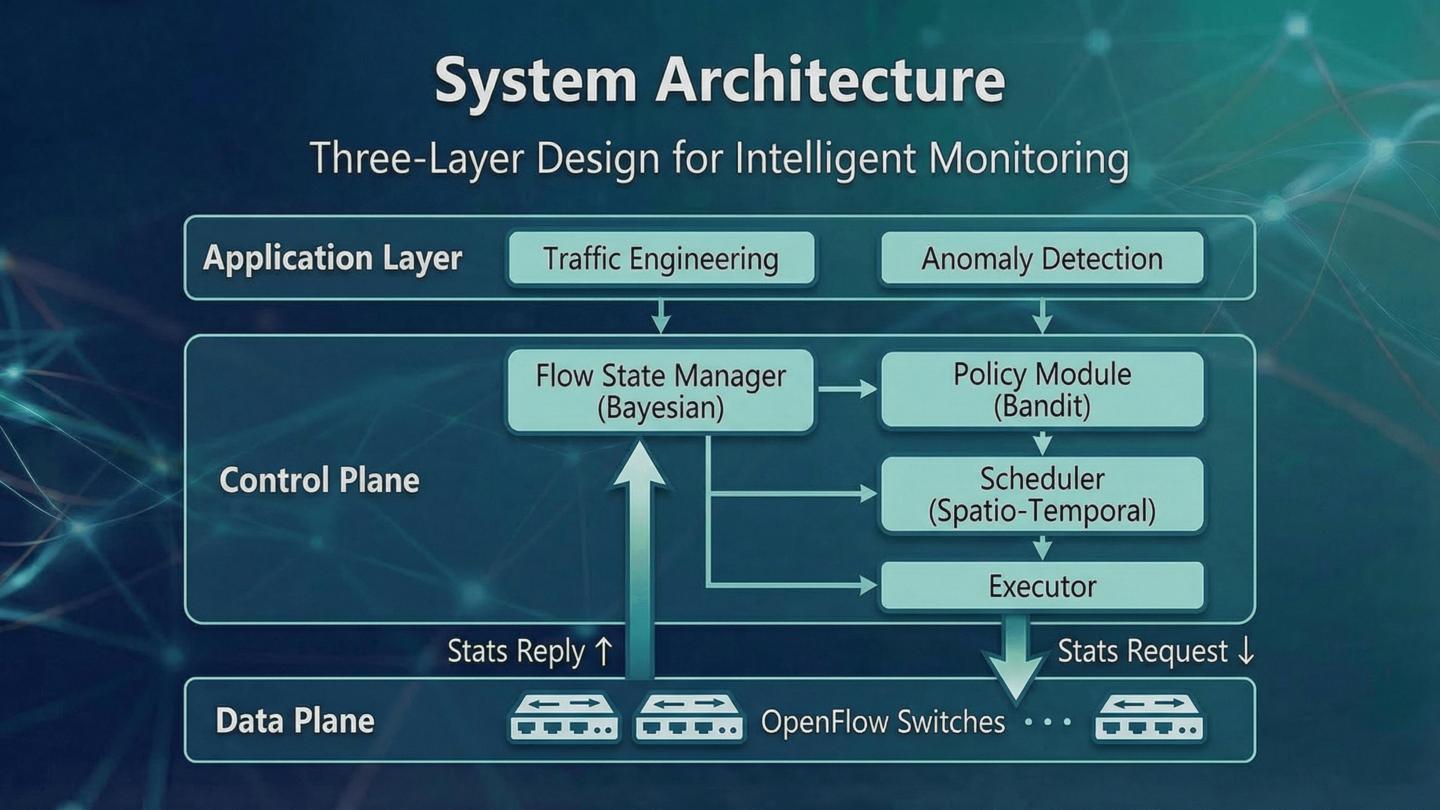
Lets look at how we architected BRIGHT to function within a standard SDN environment. We designed BRIGHT as a three-layer system to cleanly separate the core intelligence from the physical data plane. The Application Layer sits at the top, consuming our accurate traffic matrices for things like traffic engineering and anomaly detection. This is the business logic that drives the whole monitoring process. The real intelligence lives in the Control Plane. Here, five key modules work together to execute the adaptive monitoring loop. The Flow State Manager is critical; it holds the Bayesian model for every flow, giving us the estimate and the uncertainty. The Policy Module, which well discuss shortly, decides the overall monitoring strategy by selecting a template. Then, the Spatio-temporal Scheduler translates that high-level strategy into concrete OpenFlow requests, deciding exactly which switch to query and when. Finally, the Data Plane is just the standard OpenFlow switches, receiving requests and sending back counter samples. This modular design ensures that BRIGHT is both powerful and compatible with existing SDN infrastructure. This leads us directly to the foundation of our intelligence: the Bayesian state estimation.
|
 IEEE/ICACT20260358 Slide.06
[Big Slide]
[YouTube]