 |
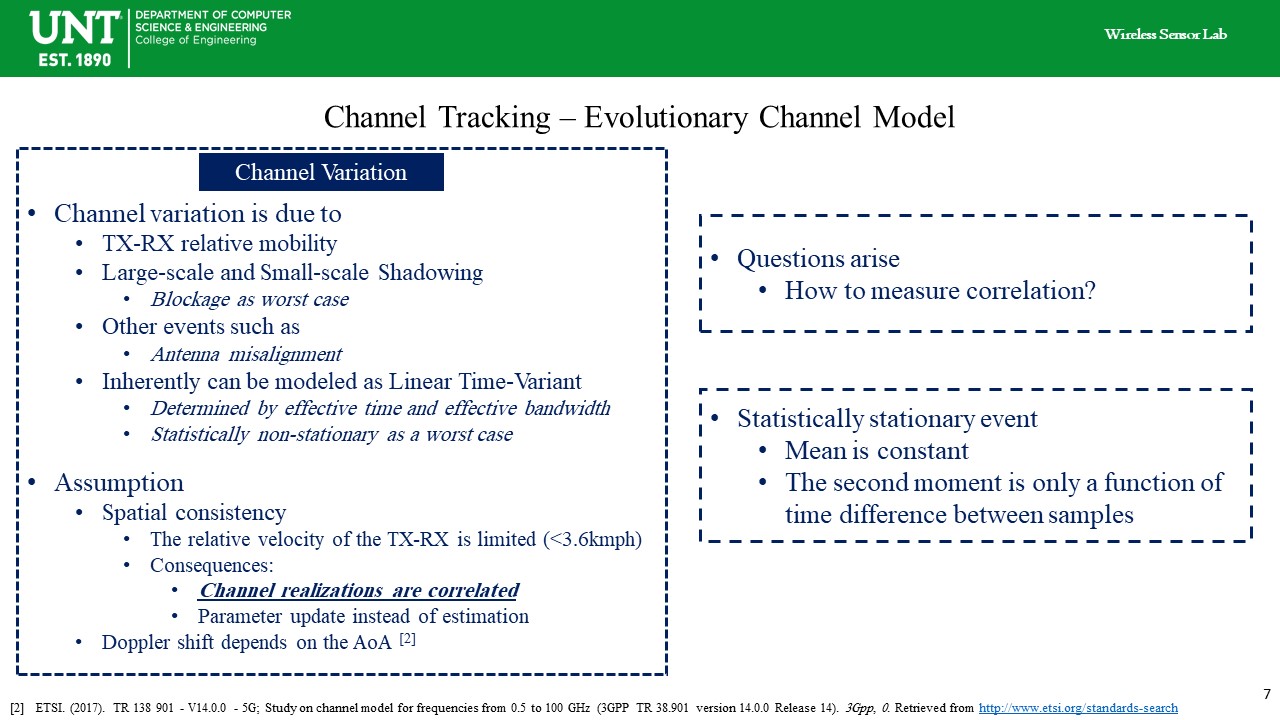
Channel varies with time because of several reasons—first, due to the receiver and transmitter mobility. Second, due to the artifacts such as antenna misalignment and, most importantly, shadowing and blockage. The best approach to model the time-variant channel is the linear time-variant model. By linearity, we make sure that the multiple communication paths are added up linearly. We also assume that the channel realizations are correlated under spatial consistency conditions. In spatial consistency mode, the transmitter and receiver relation speed is limited to less than 3.6kmph. The channel realizations that are measured close to each other temporally or spatially are correlated under spatial consistency. Moreover, we assume that the transmitter is fixed, and the Doppler shift is reflected on the AoA. By measuring the correlation order between the channels, we can measure the spectral overlap between the channels.
|
 IEEE/ICACT20210129 Slide.07
[Big Slide]