 |
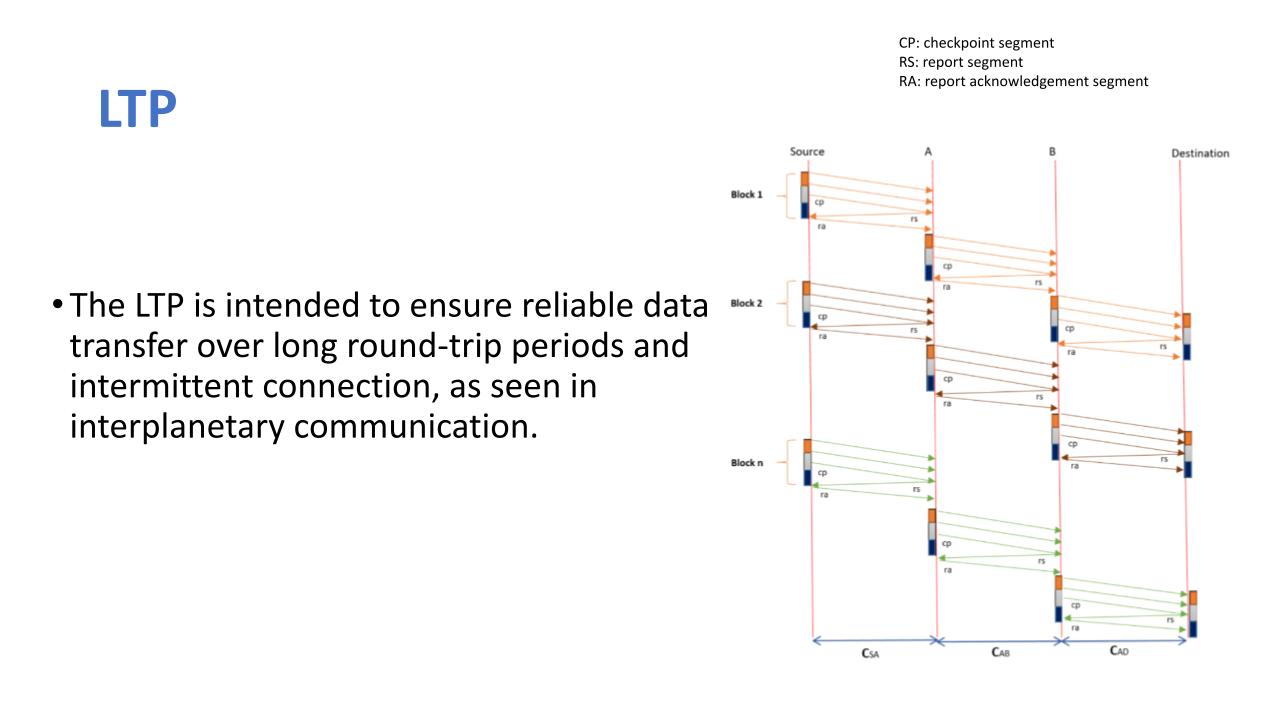
The LTP works with the concept of retransmission and it is the transport protocol which lies on layer four of the DTN architecture. It is intended to ensure reliable transmission of data transfer over long round trip periods amidst intermittent condition as seen in the interplanetary communication. From the figure it is seen that we have four nodes; Source, Destination, node A and node B in what call the multi-hop scenario. This scenario works such that data goes through several hops starting from the source through nodes A and B before it gets to the destination. Following the transmission of a block, the sender transmits a checkpoint (CP) segment. The receiver checks for segment loss within the block after receiving the CP segment and sends a report segment (RS) to the sender to indicate any loss. If no loss is discovered, the receiver acknowledges the sender cumulatively with RA; otherwise, RS tells the sender of the missing data, forcing the sender to retransmit, followed by another CP at the end of the transmission. To ensure delivery, both CP and RS segments are sent with a timer in LTP. They are then retransmitted if there is a timeout. This process is repeated at each node until the data finally gets to the destination.
In our study, we performed initial simulations based on a no error policy/ no error probability so all that we can determine the rate at which data is transmitted at a near perfect condition.
|
 IEEE/ICACT20240287 Slide.07
[Big Slide]