 |
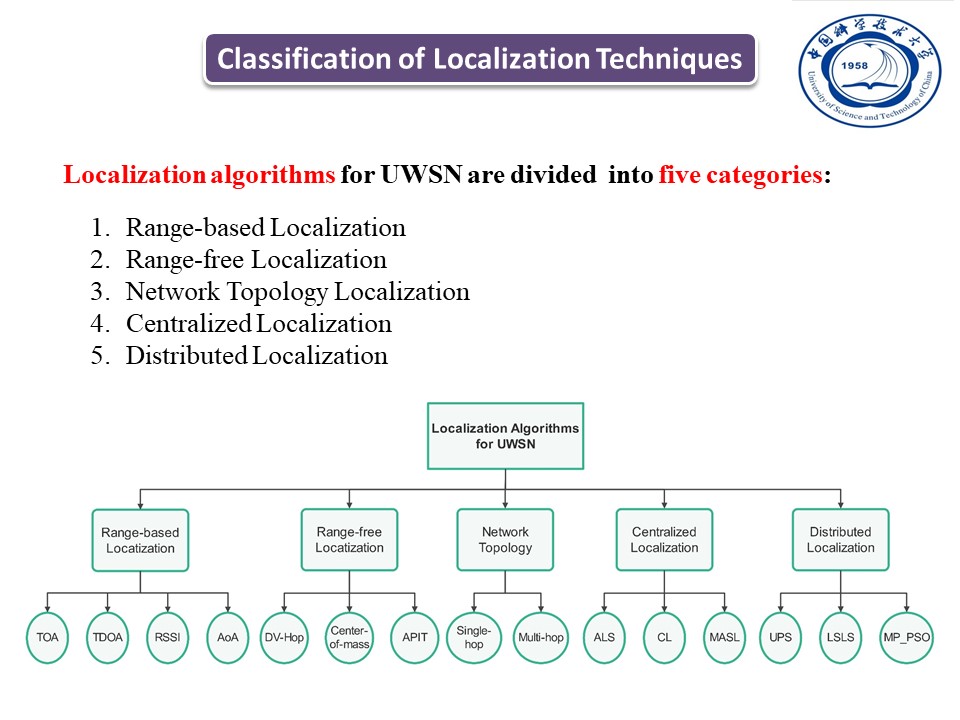
We divided the localization algorithms for UWSNs into five categories:(1) range-based, (2) range-free, (3) network-based topology, (4) centralized, and (5) distributed localization schemes, as seen in this figure. Here is an explanation for each category:
(1) The ranging-based algorithm employs varied techniques, such as Angle of Arrival (AOA), Time of Arrival (TOA), Received Signal Strength Indication (RSSI), and Time Difference of Arrival (TDOA), to measure node distances to anchor nodes and determine unknown node locations. (2) The range-free algorithms estimate node distances based on hop count and directional data, converting this information into approximate node positions. (3) The network-based topology localization, in which the localization algorithms are categorized into two primary types based on network topology and node connectivity: single-hop and multi-hop. (4) In a centralized localization approach, all nodes transmit collected data to a central
sink node for processing. (5) The distributed localization
method involves nodes processing their information autonomously and then interchanging this data for localization, making it ideal for large-scale UWSNs. This enables real-time node position retrieval while distributing computational tasks across the network. |
 IEEE/ICACT20240426 Slide.07
[Big Slide]
[YouTube]