 |
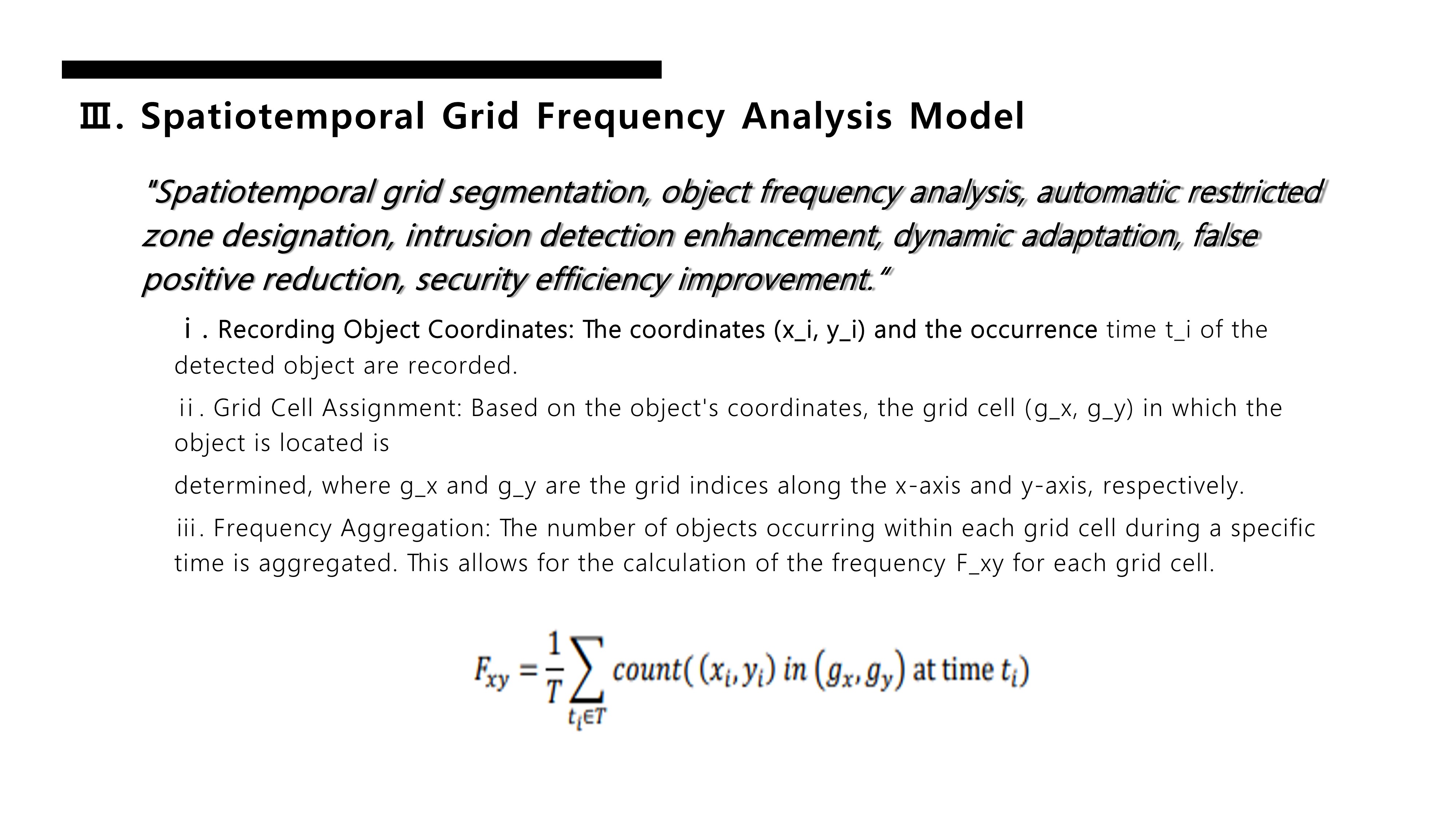
To enhance intrusion detection accuracy, our system utilizes a spatiotemporal grid segmentation approach. This method enables object frequency analysis and automatic restricted zone designation, improving security efficiency while reducing false positives.
The system first records the coordinates (xᵢ, yᵢ) and occurrence time (tᵢ) of each detected object.
This data allows us to track movement patterns over time, which is essential for detecting unusual activities.
Next, each object is mapped to a specific grid cell (gₓ, gᵧ) based on its location within the surveillance area.
These indices represent the object¡¯s position along the x-axis and y-axis, helping segment the surveillance footage into manageable spatial regions.
The system then aggregates the number of objects detected within each grid cell over a specific time frame.
This allows us to calculate the frequency (Fₓᵧ) of object occurrences, which is crucial for identifying patterns of activity and potential security threats.
By continuously analyzing object frequency, our system can dynamically adapt to changes in the environment, improving intrusion detection, reducing false positives, and enhancing overall security efficiency.
Next, I will discuss how this model helps designate restricted zones automatically based on real-time surveillance data.
|
 IEEE/ICACT20250047 Slide.07
[Big Slide]