 |
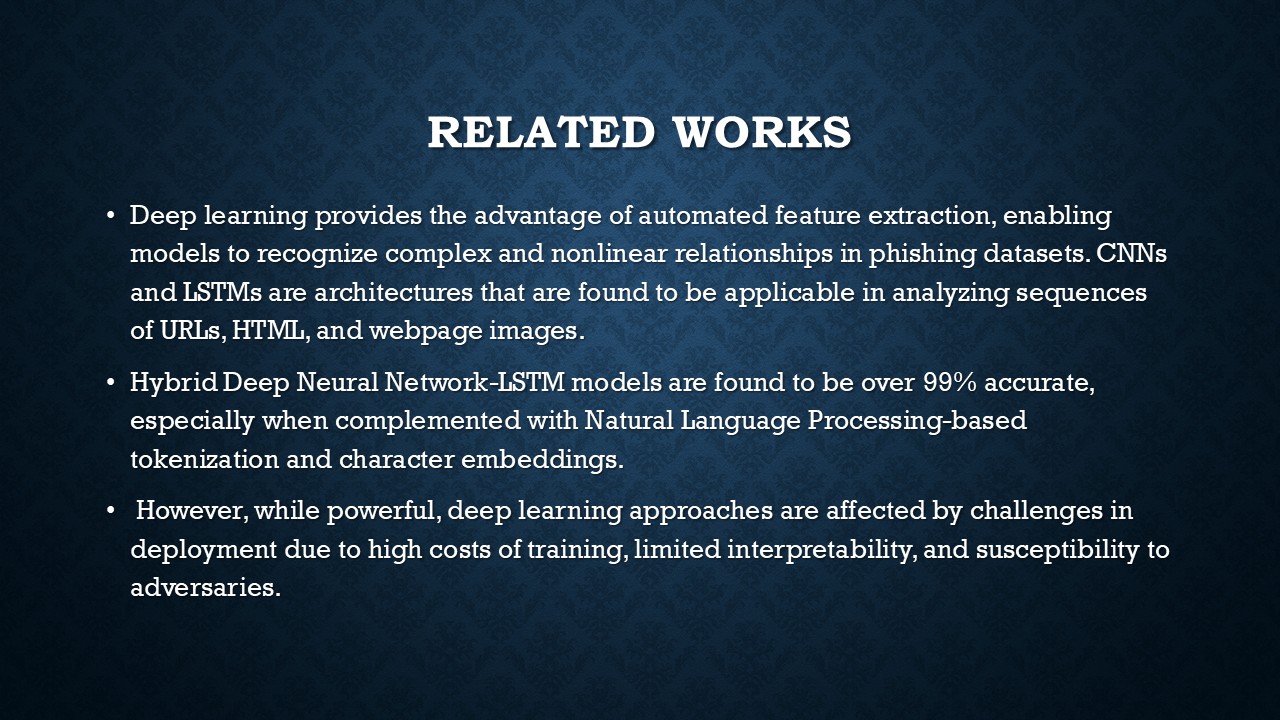
Deep learning techniques offer significant advantages in phishing detection, particularly through automated feature extraction. This allows models to identify complex and nonlinear patterns within phishing datasets. Architectures such as Convolutional Neural Networks (CNNs) and Long Short-Term Memory (LSTM) networks are commonly used to analyze sequential and structured data, including URLs, HTML content, and webpage images.
Studies have shown that hybrid deep learning models, such as Deep Neural Network combined with LSTM, can achieve accuracy rates exceeding 99%, especially when integrated with Natural Language Processing techniques like tokenization and character-level embeddings.
However, despite their strong performance, deep learning approaches face several practical challenges. These include high computational and training costs, limited model interpretability, and vulnerability to adversarial attacks, which can impact their reliability and deployment in real-world cybersecurity environments. |
 IEEE/ICACT20260061 Slide.07
[Big Slide]