 |
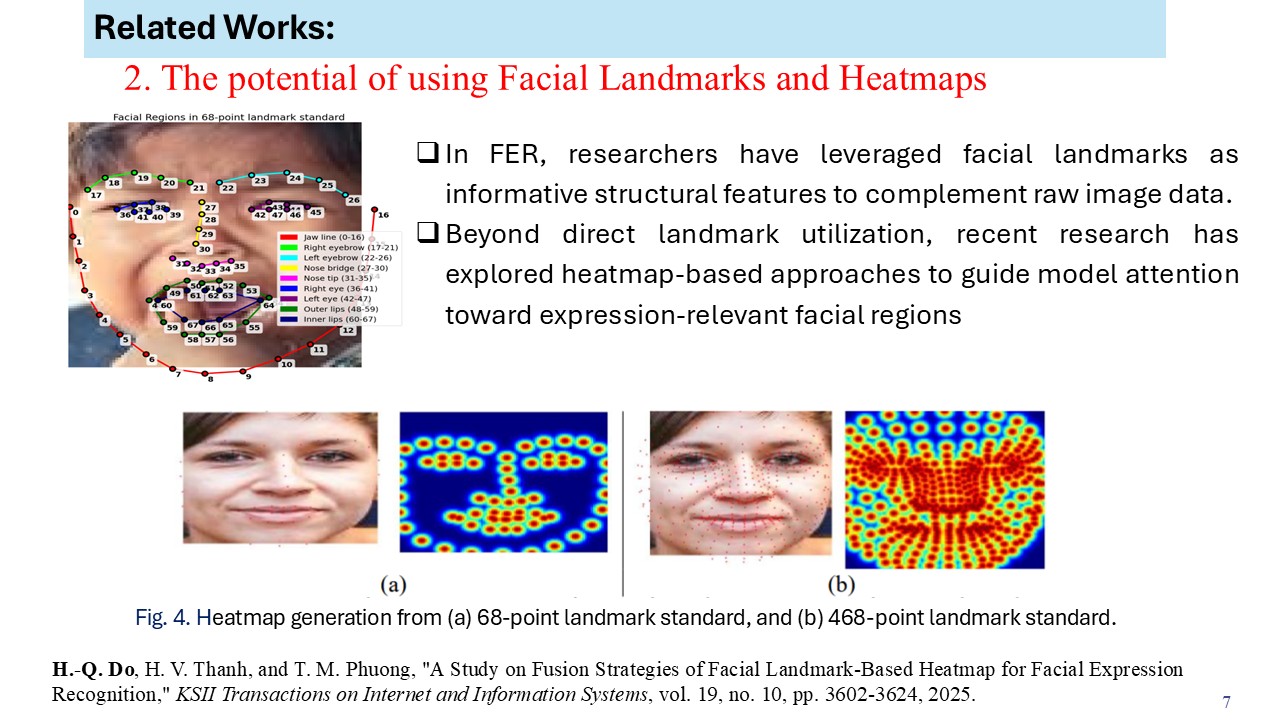
Facial landmark detection, which identifies and localizes predefined keypoints on human faces, has become instrumental in numerous face analysis applications. In FER, researchers have leveraged facial landmarks as informative structural features to complement raw image data. Jung et al. in 2017 pioneered this direction by introducing a dual-network CNN architecture that processes both facial images and landmarks through weighted summation. Building on this foundation, Meng et al. in 2022 proposed a dual-branch network combining CNN and Graph Convolutional Networks (GCN)
Beyond direct landmark utilization, recent research has explored heatmap-based approaches to guide model attention toward expression-relevant facial regions. Notably, in previous work, we addressed the question of how to effectively represent facial landmark data: whether raw coordinate positions or heatmap-based representations provide better inputs for neural networks, and how to identify optimal fusion strategies for combining heatmap-based features with image-based features.
These key developments in multi-view learning approach, and facial landmark utilization that form the foundation for this work where we propose a multi-view framework to improve FER performance. It is named as MV-FER. |
 IEEE/ICACT20260151 Slide.07
[Big Slide]