 |
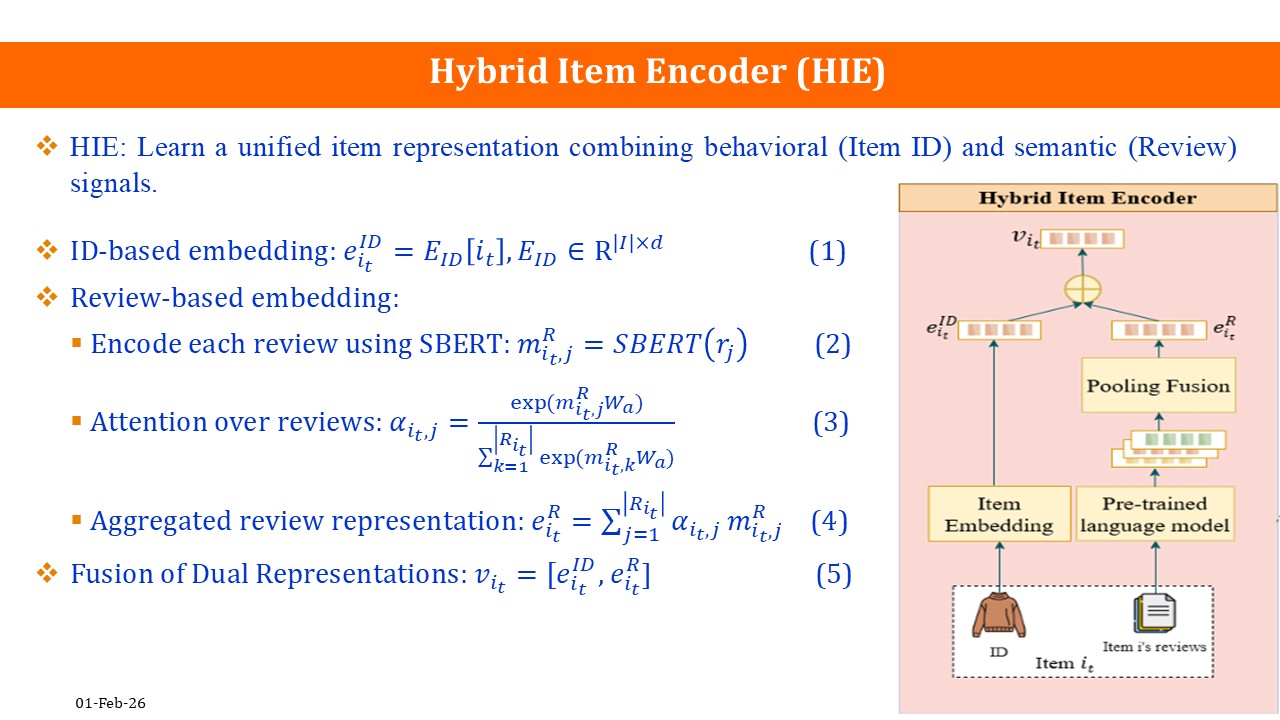
In this slide, I introduce the Hybrid Item Encoder, or HIE, which is the core component of the HiSeR model.Ħħ The goal of HIE is to learn one unified representation for each item by combining two complementary sources of information: behavioral signals from item IDs and semantic signals from user reviews.
First, ID-based representation. As shown in Equation (1), each item ID is mapped to a learnable embedding vector from the item embedding matrix. This representation captures collaborative behavioral patterns learned from user–item interaction histories.
Second, review-based representation. Each item is associated with multiple user reviews. As described in Equation (2), each review is encoded into a semantic vector using Sentence-BERT.
However, not all reviews are equally informative. Some reviews are generic, while others describe important product characteristics. To address this, HIE applies an attention mechanism over reviews. In Equation (3), an attention weight is assigned to each review to measure its importance.
Then, as shown in Equation (4), the final review-based representation of the item is computed as a weighted sum of all review embeddings. This allows the model to emphasize semantically meaningful reviews and reduce the impact of less relevant ones.
Finally, fusion of dual representations.�As shown in Equation (5), the ID-based embedding and the review-based embedding are concatenated to form the final hybrid item representation. This hybrid embedding jointly preserves collaborative knowledge from interactions and semantic knowledge from reviews, and is used as the item representation for subsequent sequential modeling.
|
 IEEE/ICACT20260275 Slide.07
[Big Slide]