 |
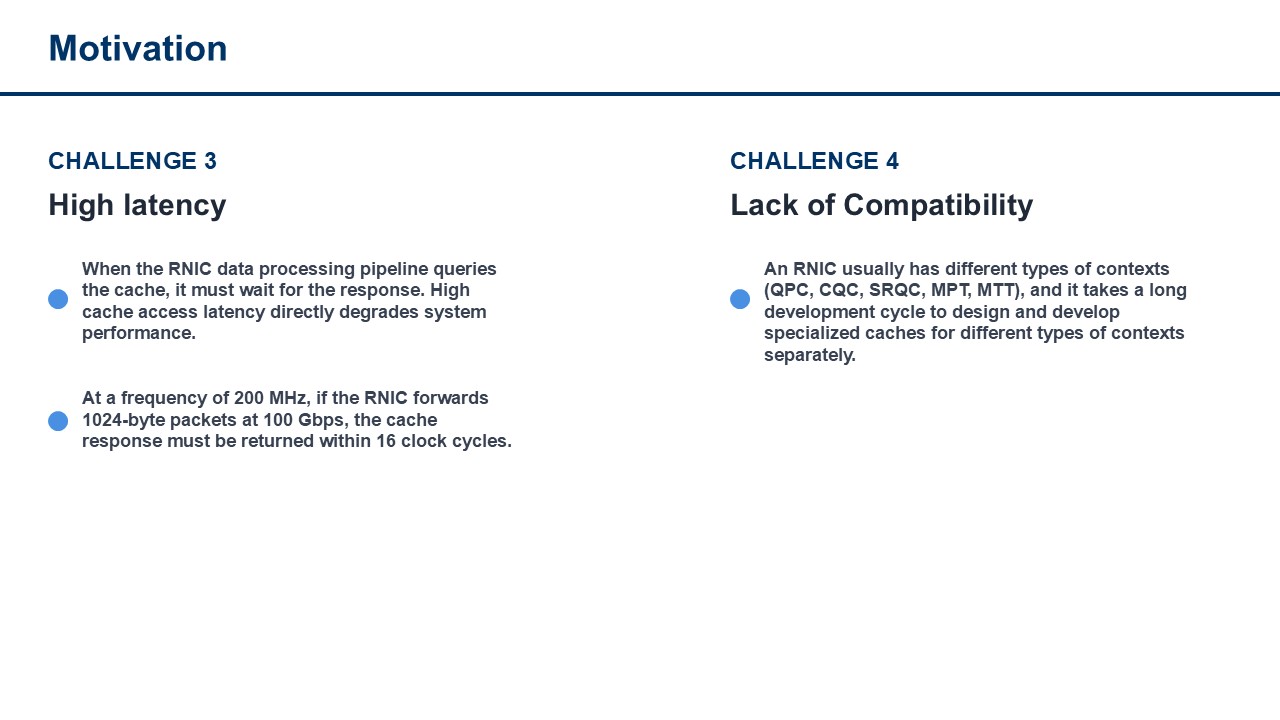
The third challenge is High Latency.
When the RNIC data processing pipeline queries the cache, it must wait for the response before proceeding. So high cache access latency directly degrades overall system performance.
To give you a concrete example: at a clock frequency of 200 MHz, if the RNIC needs to forward 1024-byte packets at 100 Gbps line rate, the cache must return a response within just 16 clock cycles. Thats an extremely tight timing budget, and any delay can become a bottleneck.
The fourth challenge is Lack of Compatibility.
As we saw earlier, an RNIC manages several different types of contexts , QPC, CQC, SRQC, MPT, MTT, and so on. In traditional designs, engineers often build specialized caches for each context type separately. This approach works, but it requires a long development cycle and makes the system harder to maintain and extend.
What we really need is a unified, general-purpose cache architecture that can handle all these context types efficiently. |
 IEEE/ICACT20260320 Slide.07
[Big Slide]
[YouTube]