 |
From here, I will explain the proposed method, Cooperative MIMO applied null beamforming to self.
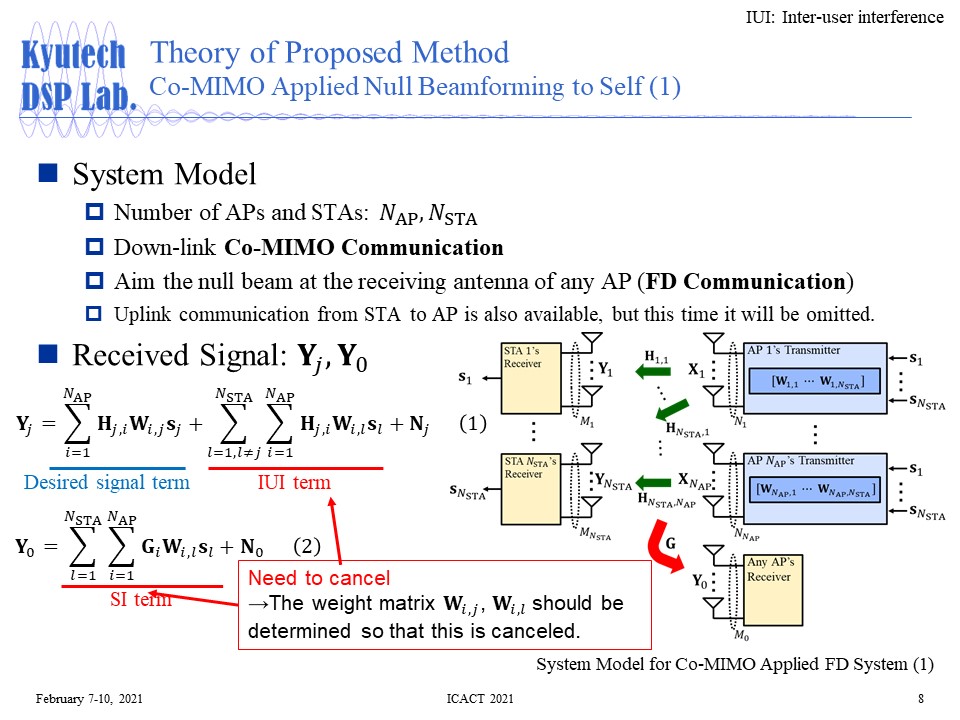
For illustration purposes, consider a situation where you have N_AP access points (APs) and N_STA stations (STAs), as shown in this figure.
These APs and STAs attempt to perform full-duplex wireless communication while performing cooperative MIMO.
In other words, the purpose of this is to cancel the self-interference by applying the proposed method to the receiving antenna of the AP that receives Y_0 in this figure.
Furthermore, in actual wireless communication, uplink communication is also performed at the same time, but this is omitted in this explanation.
At this time, the received signal Y_j of each STA and the received signal Y_0 of the AP whose self-interference should be canceled are expressed as in equations 1 and 2.
Looking at the formula, we can see that in addition to the desired signal indicated by the blue line, the self-interference signal indicated by the red line and the inter-user interference signal are generated.
In particular, G_i included in the self-interference section is the spatial channel matrix from AP to AP, that is, the self-channel matrix.
In other words, in order to communicate correctly, it is essential to cancel this self-interference and inter-user interference signal, and in order to cancel this, it is necessary to properly determine the weight matrix Wij of the AP.
|
 IEEE/ICACT20210238 Slide.08
[Big Slide]