 |
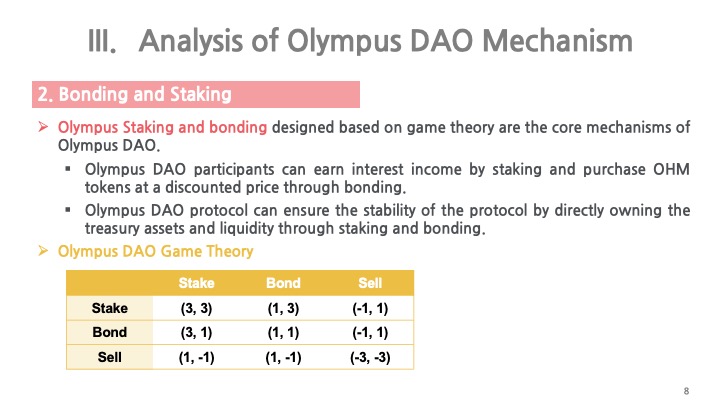
Staking and bonding designed based on game theory are the core mechanisms of Olympus DAO. Olympus DAO participants can earn interest income by staking and purchase OHM tokens at a discounted price through bonding. In addition, the Olympus DAO protocol can ensure the stability of the protocol by directly owning the treasury assets and liquidity through staking and bonding.
Bonding plays an important role in increasing the assets owned by the treasury. Bonders can purchase OHM tokens at a discount from the market price. The bonder can hold the OHM token and participate in staking or sell it after a certain period of time, which is about 5 days by default, to get a profit. The protocol will increase the treasury assets by receiving the payment for purchasing tokens from the bonder.
Through staking, the staker locks the OHM token and receives rebase rewards accordingly. Olympus DAO drives demand for OHM tokens by offering high APY to stakers. When OHM tokens are staked, the staker will receive the same amount of sOHM. And the quantity of sOHM tokens increases by once every 8 hours according to the APY, the yield given by the smart contract. The staker will receive the same amount of OHM tokens as sOHM when unstaking.
Olympus DAO uses (3,3) memes to explain Olympus DAO game theory strategies. Olympus DAO participants can take three actions: staking, bonding, and selling. Staking and bonding, which increase the value of OHM tokens, are positive actions for the protocol, but selling can cause the protocol's value to decline. The following table quantifies the profit and loss according to the actions of Olympus DAO participants. First, +2 points, +1 points, and -2 points are given as basic points for each action of staking, bonding, and selling. In addition, +1 point or -1 point is given in consideration of the profit or loss caused by the actions of others.
|
 IEEE/ICACT20230040 Slide.08
[Big Slide]