 |
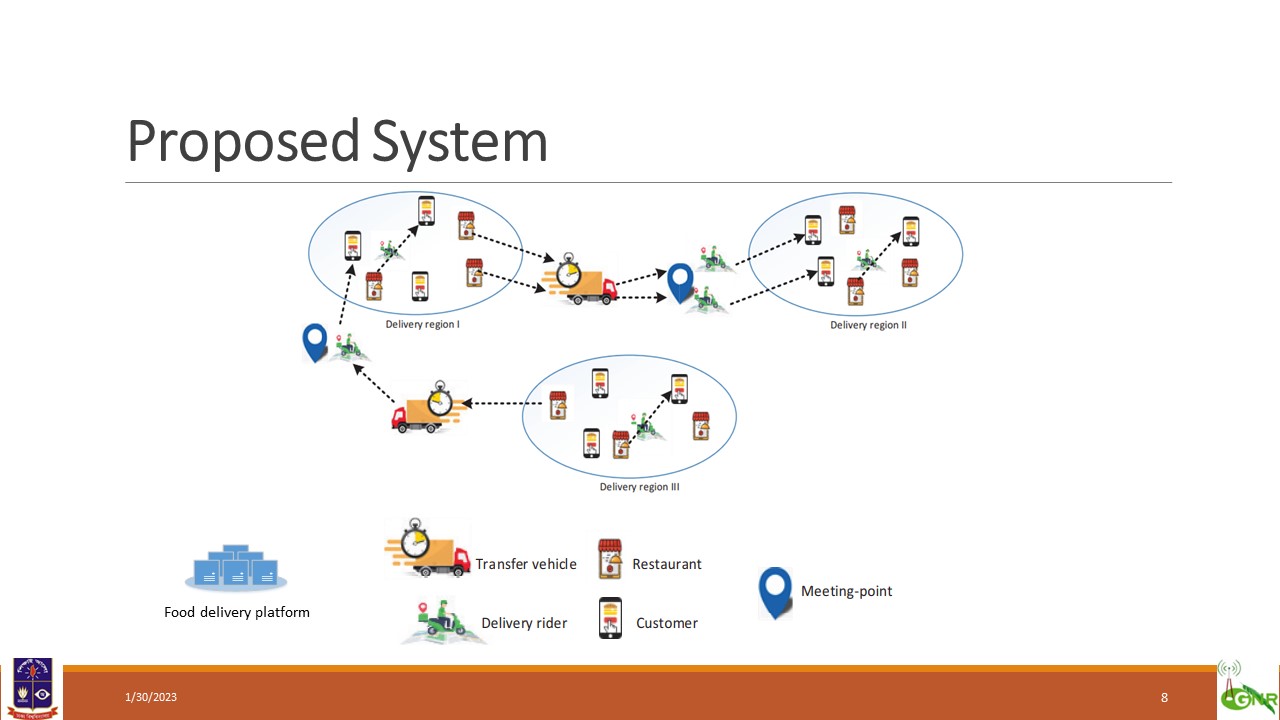
We consider an online food delivery system consists of platform, customer, restaurant , transfer vehicle and worker. Platform centrally coordinates the interaction among the entities and they are connected to the platform through registration. A customer can place food order from a local restaurant which is considered as intra-region order or place order from a distant restaurant beyond
his/her region which is considered as inter-region order. In case of inter-region delivery, dedicated vehicles are used for transferring orders to the workers of delivery regions at a mutual meeting-point for delivering the orders to the respective customers. We assume a transfer vehicle is always available in the pool; if not, customers whose orders are associated with this vehicle should be notified. This transfer vehicle based inter-region and intra-region strategy is illustrated in this figure. Platform, restaurants and workers get their appropriate portion of revenue when an order is completed successfully. For inter-region orders, the platform generates an initial set of orders based on the region of delivery. Then, after being allocated by platform, the transfer vehicle collects orders from restaurants and delivers them to the corresponding workers at the meeting-point within the estimated delivery time. Manhattan distance is calculated to estimate the position (x; y) of meeting-point of transfer vehicles and workers considering the characteristics of the complicated urban road network traffic state as in [7]. In the proposed system is assumed to have several meeting points to ensure faster delivery based on the distance between surrounding intra-regions. In this work we emphasis on the allocation of inter-region orders, thus we consider the spatial information of only inter-region orders and transfer vehicles.
|
 IEEE/ICACT20230132 Slide.08
[Big Slide]
[YouTube]