 |
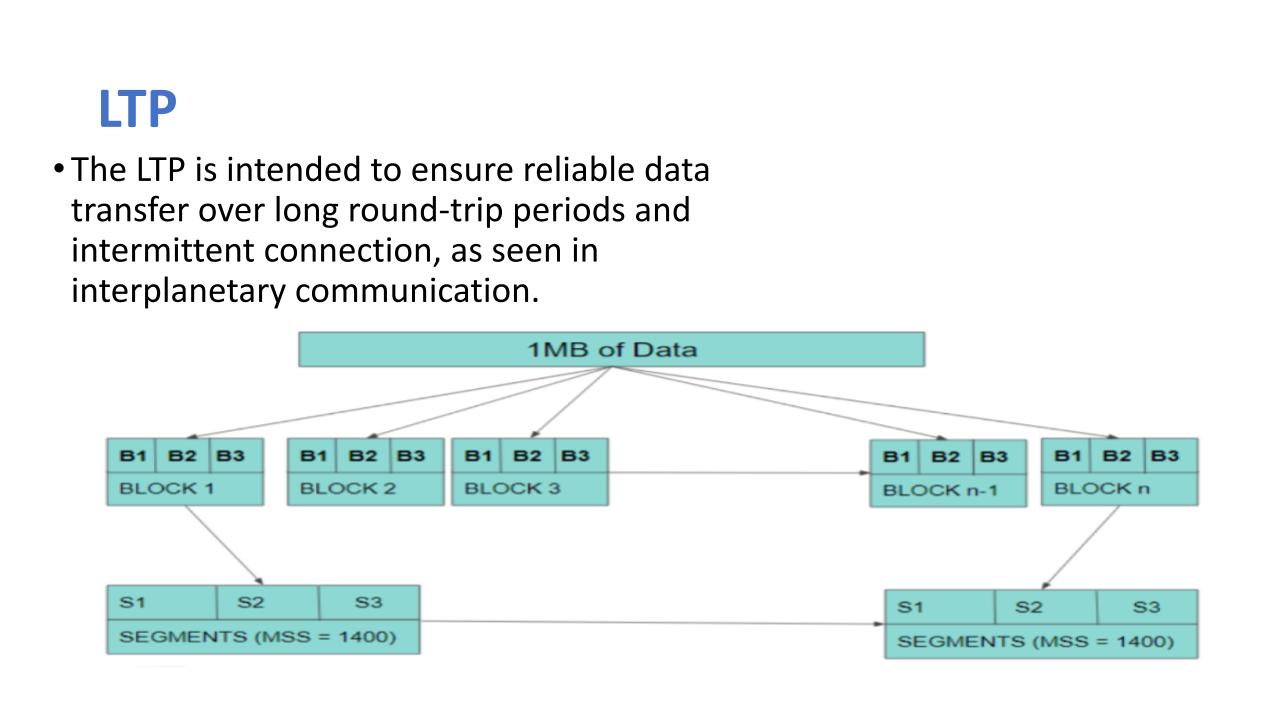
A method of bundle aggregation is applied to determine the good put and latency of file transfer using a multi-hop scenario. Bundle aggregation allows for bundles to be transferred in batch or single pairs. The file is split into a number of bundles and then these bundles are either joined in unity to form a block or number of blocks (from ith block to nth block) or in pairs/aggregated pairs. In this study, the bundle aggregation starts from a bundle size of three to a nth number of bundles in the block. We transmitted one megabyte of data at initial simulation. From the figure, we see that the one megabyte of data was split into several blocks and then these blocks have what we call bundles. These are the bundles that are being stored in the bundle protocol, so we have block 1, block 2, block 3 down to block n. Each block has bundles depending on the amount of bundles you want to set in a block. Furthermore, blocks are then divided into several segments, obeying the set guidelines for DTN architecture and for transfer in inter-satellite connection or connectivity. The blocks are split to segment, and then the maximum segment size we used was 1,400bytes as opposed to the regular MSS in TCP which is 1460bytes |
 IEEE/ICACT20240287 Slide.08
[Big Slide]