 |
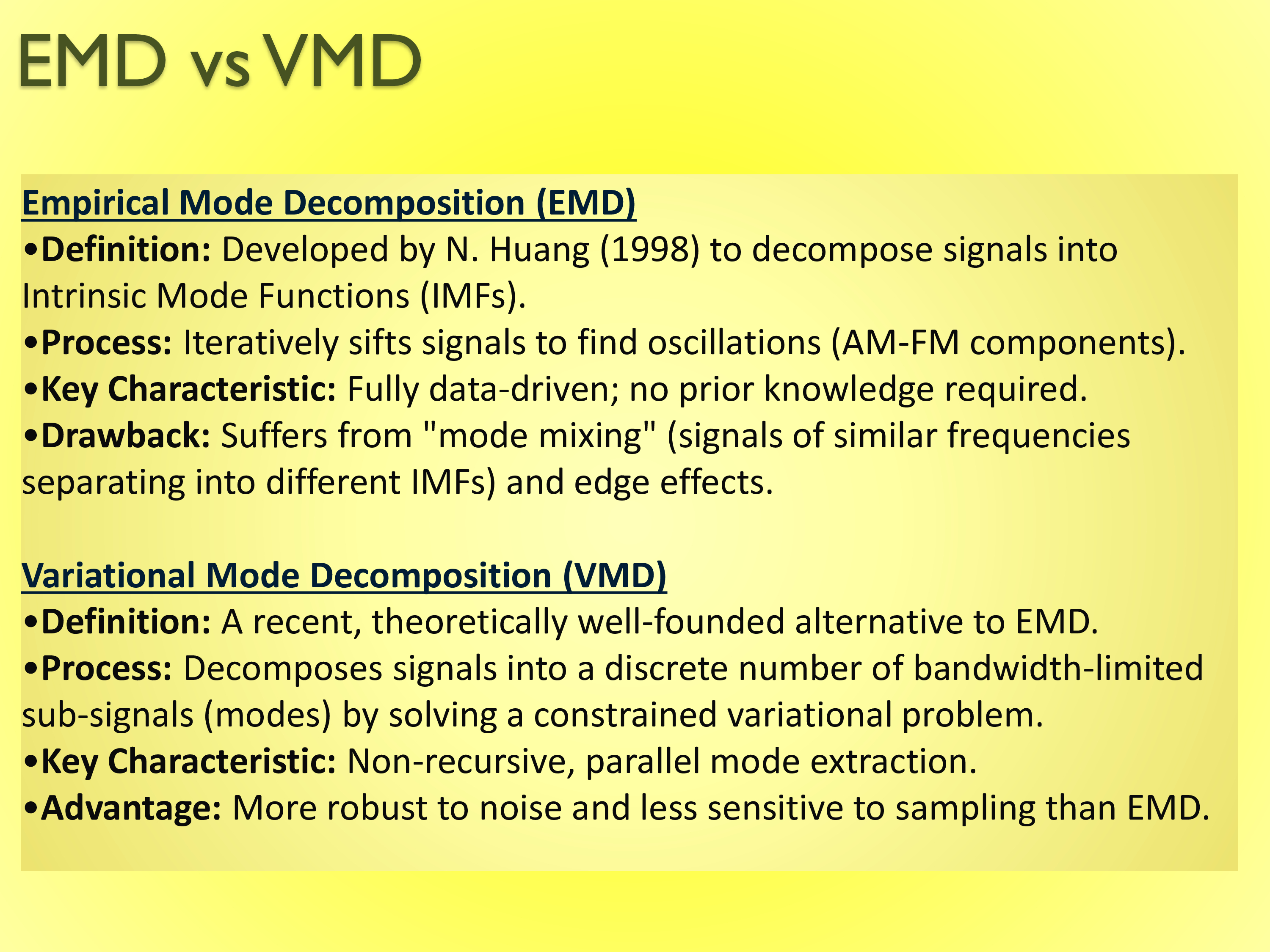
Empirical Mode Decomposition (EMD)
What it does: Decomposes a signal into a set of Intrinsic Mode Functions (IMFs).
Strengths: Fully adaptive, requires no prior knowledge of the signal frequency content.
Weaknesses:
Mode Mixing: Similar frequencies may exist in different modes, or a single mode may contain widely different frequencies.
Boundary Effects: The sifting process can produce artifacts at the beginning and end of the data.
Variational Mode Decomposition (VMD)
What it does: Decomposes a signal into a discrete number of band-limited Variational Mode Functions (VMFs) by solving a constrained optimization problem.
Strengths:
Robustness: Effectively handles noise and non-stationary characteristics, making it better for real-world signals.
Frequency Separation: Produces cleaner, more distinct frequency modes.
Weaknesses: Requires defining the number of modes (
) before decomposition. |
 IEEE/ICACT20260121 Slide.08
[Big Slide]