 |
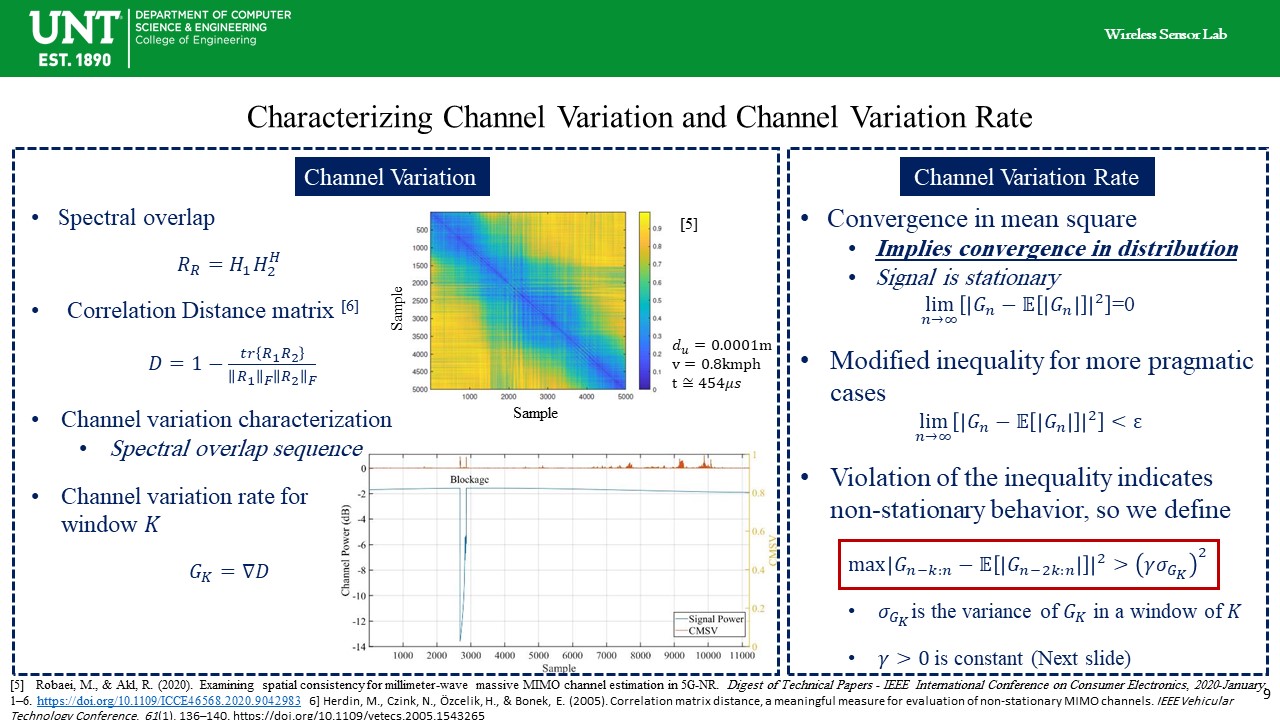
The correlation between channels can be measured using the correlation distance matrix recommended by Herdin et al. The correlation order determines the spectral overlap. The figure at the top shows the correlation for the 5000 channel realizations. As it is evident, the correlation disappears as the distance between the channels increases. We are also interested in how the spectral overlap varies with time. So, we create a sequence of the spectra overlaps. Then, we calculate the gradient of the spectral overlap sequence within some interval.
In order to detect the significant channel variation, we are using the convergence in mean square. It is known that the convergence in mean square implies convergence in the distribution. We use this idea to detect significant local channel variation. If the maximum value of convergence in mean square is greater than the local spread of the spectral overlap, then it means the local mean of the spectral overlap has been changes significantly. The maximum spread spectral overlap will be placed in the tail of the local distribution of the spectral overlap. As a result, its appearance increases the value of the convergence in mean square (because it is far from the mean).
This composes a decision rule for the adaptive channel estimation –tracking.
The figure at the bottom shows the blockage detected using the convergence in mean square. |
 IEEE/ICACT20210129 Slide.09
[Big Slide]