 |
I will explain the details of virtual city virtual Sejong city model in this slide.
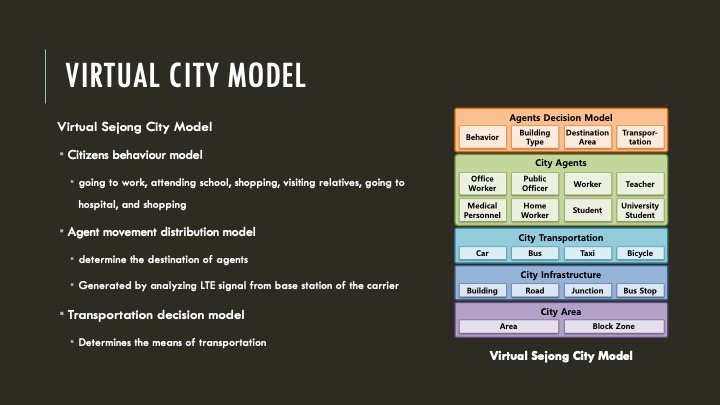
First, agent behaviour model resolves citizens’ behaviour and movement.
Citizen agents are classified by occupation and autonomously perform behaviours such as going to work, attending school, shopping, visiting relatives, going to hospital, and shopping
Agent behaviour probability distribution is generated according to the probability of actions by occupation in the National Living Time Survey.
Next, the destination of agents is determined according to the movement distribution model.
The movement distribution is generated by analyzing LTE signal from base station of the carrier.
Finally, transportation decision model determines the means of transportation in consideration of the distance, presence or absence of transportation, and route.
|
 IEEE/ICACT20210167 Slide.09
[Big Slide]