 |
To avoid a concentration of probe packets at links near the measurement host, especially in large networks, each probe packet should traverse each link one and only once. The measurement route avoids a long terminal path because in a long terminal path, when a number of links on a path are not actually lossy but with a light loss rate, an accumulated loss rate over those links will cause a wrong decision to narrow a segment that likely includes actual lossy links, resulting in an unnecessary increase of accesses to OpenFlow switches.
Furthermore, a long terminal path requires a large number of probe packets to operate accurately because an incidental reduction of probe packets in upstream, e.g., due to heavy packet losses at a failure link, will degrade the reliability of measurement results for links in its downstream.
At the same time, the measurement route should keep a small number of terminal paths, i.e., a small number of leaf ports needed to initially access, resulting in a small number of accesses to OpenFlow switches to locate all high-loss links.
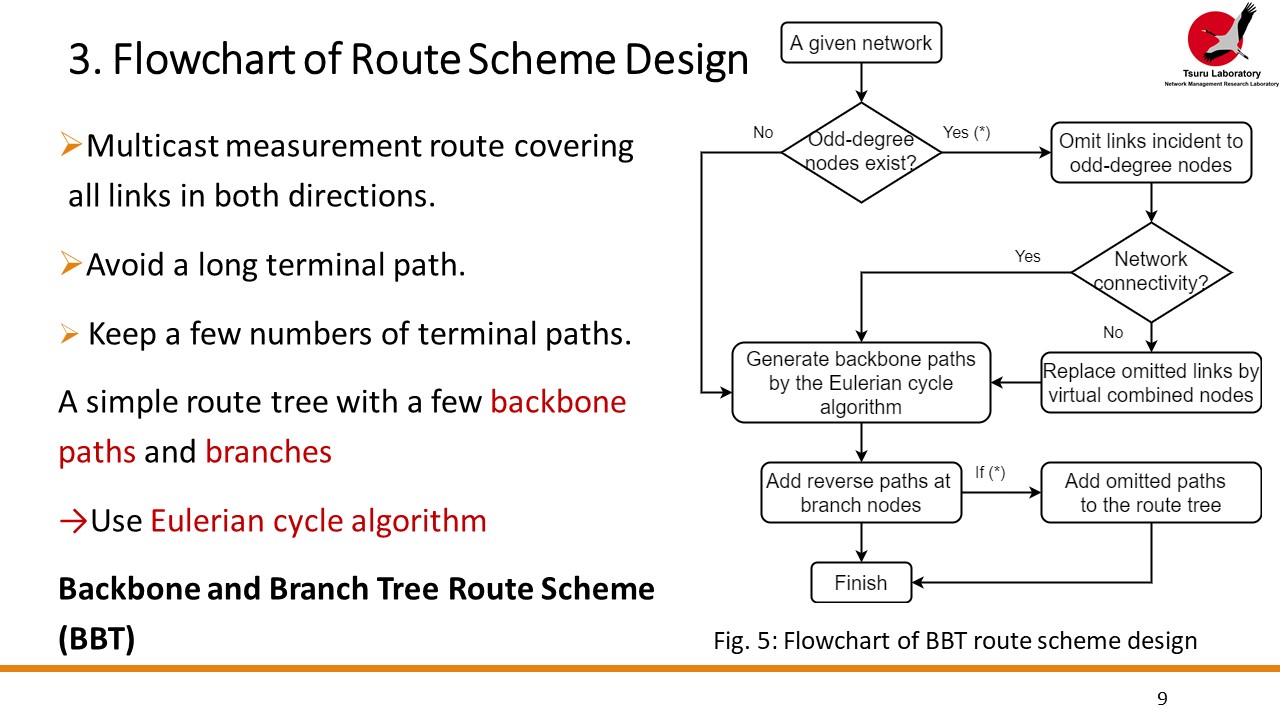
Therefore, a newly route scheme called the backbone-and-branch tree route scheme (BBT) is proposed and its flowchart is illustrated in Figure 5.
In the BBT scheme, the Eulerian cycle algorithm is applied to the original undirected graph.
|
 IEEE/ICACT20210168 Slide.09
[Big Slide]