 |
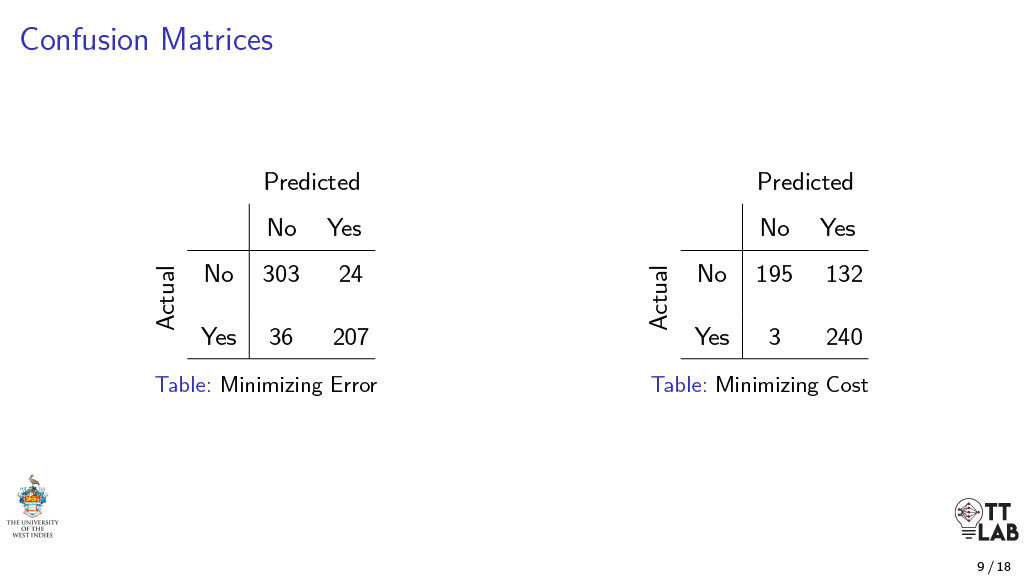
Initially when our model is trained without incorporating
costs, the resulting confusion matrix on the cross-validated
training set was computed as shown in the left table. This therefore gives an accuracy of 89.5%, with a success rate of 88.9%. However, there are many false positives (24) and false negatives (36) which would negatively impact the telecommunications provider financially. The cost of a false positive, that is, incorrectly predicting an upsell as successful, is much less than the cost of a false negative, that is, incorrectly predicting an upsell as unsuccessful. The cost of a false positive may only account for administrative costs. On the other hand, the cost of a false negative is the foregone benefit that would have been obtained if the customer was approached for upsell, and this benefit would be the revenue gained from the sale of the product. When applying cost weightings to the model, the number of false negatives is significantly reduced (3), as shown in the table on the right. |
 IEEE/ICACT20220017 Slide.09
[Big Slide]