 |
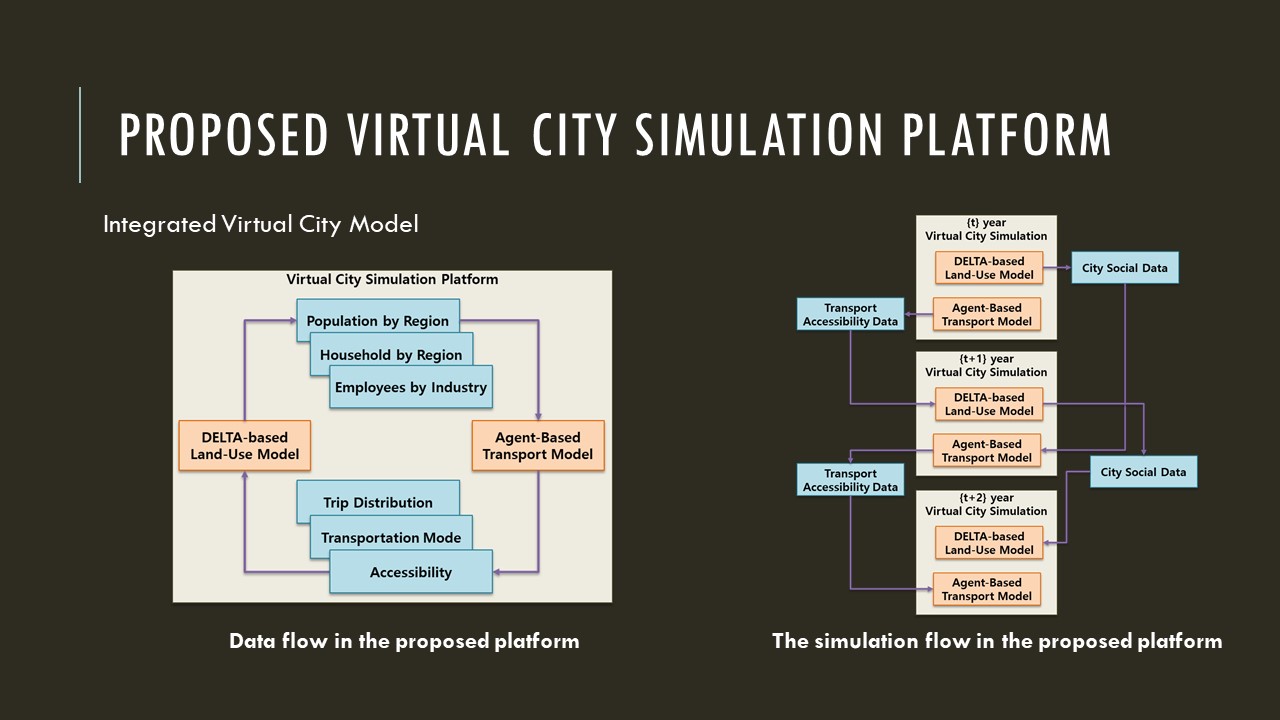
The integrated city model is driven by linking the land-use model and the transport model to simulate the circular relationship implemented with the flow of data.
The most basic relationship between subsystems in the integrated city model is the circular relationship between land-use and transport.
Through this relationship, the integrated model allows the agent to consider location attractiveness, location cost, travel cost, and accessibility together, and selects the location of residence and the destination of behavior.
In particular, the integrated model enables prediction of future urban spatial structure changes by simulating the process of continuously changing land-use patterns and movement patterns by repeatedly influencing the spatial distribution of new activities and the spatial distribution of accessibility.
|
 IEEE/ICACT20220398 Slide.09
[Big Slide]