 |
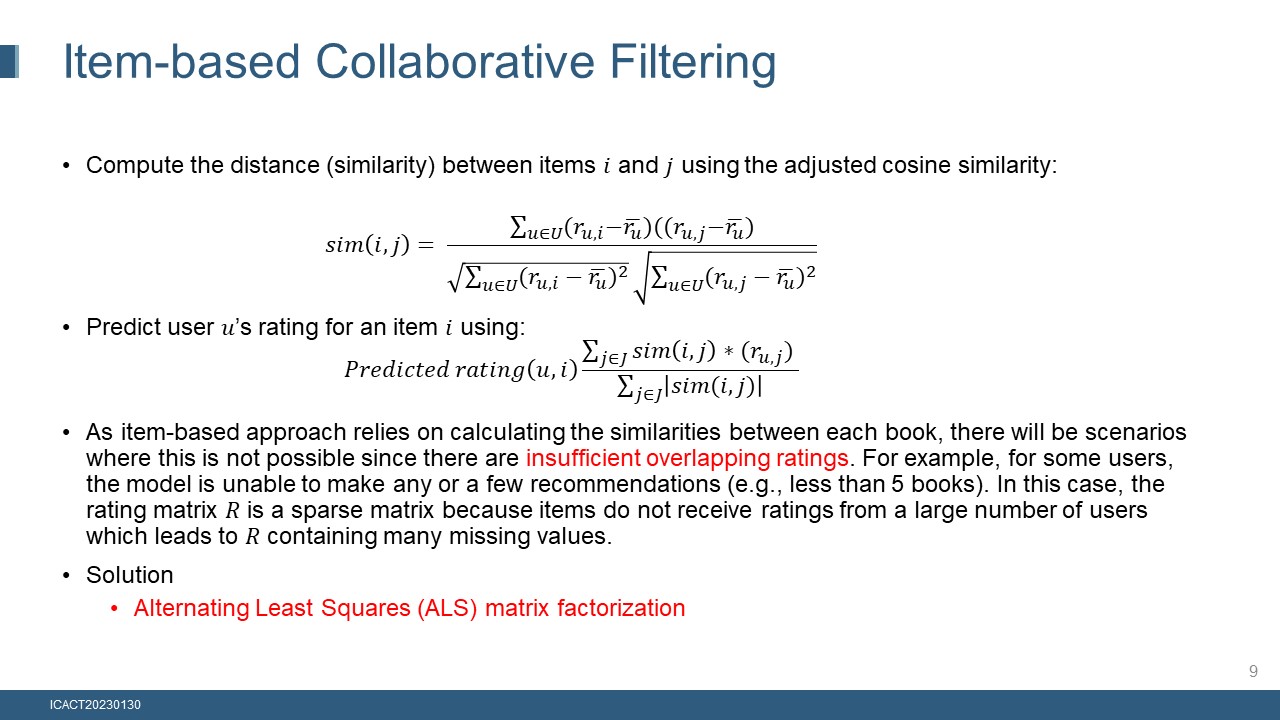
Our proposed personalized book recommender algorithm uses an item-based technique rather than a user-based technique. Since the number of users is more than the number of books in the cleansed dataset, user-based collaborative filtering is more likely to have the sparse problem than the item-based filtering.
One critical step in the item-based collaborative filtering algorithm is to calculate the similarity between items and then to select the most similar items. Here, We compute the similarity between items 𝑖 and 𝑗 using the adjusted cosine similarity by using the first formula.
where 𝑟_(𝑢,𝑖) is the rating of user 𝑢 on item 𝑖, 𝑟_(𝑢,𝑗) is the rating of user 𝑢 on item 𝑗, (𝑟_𝑢 ) ̅ is the mean rating of user 𝑢, 𝑈 is the set of all users. Each individual rating is within a scale from 0 to 10. Rating 0 indicates that the user has not yet rated this book.
Once we have the similarities between the items 𝑖 and 𝑗, we can predict user 𝑢¡¯s rating for an item 𝑖 using the second formula.
As item-based approach relies on calculating the similarities between each book, there will be scenarios where this is not possible since there are insufficient overlapping ratings. For example, for some users, the model is unable to make any or a few recommendations (e.g., less than 5 books). In this case, the rating matrix 𝑅 is a sparse matrix because items do not receive ratings from a large number of users which leads to 𝑅 containing many missing values.
To address this issue, ALS approach is used to supplement the item-based approach. One solution to the sparse matrix problem is ALS matrix factorization.
|
 IEEE/ICACT20230130 Slide.09
[Big Slide]
[YouTube]
IEEE/ICACT20230130 Slide.09
[Big Slide]
[YouTube]