 |
This slide outlines various methods for detecting time-varying anomalies. It mentions three anomaly detection methods:
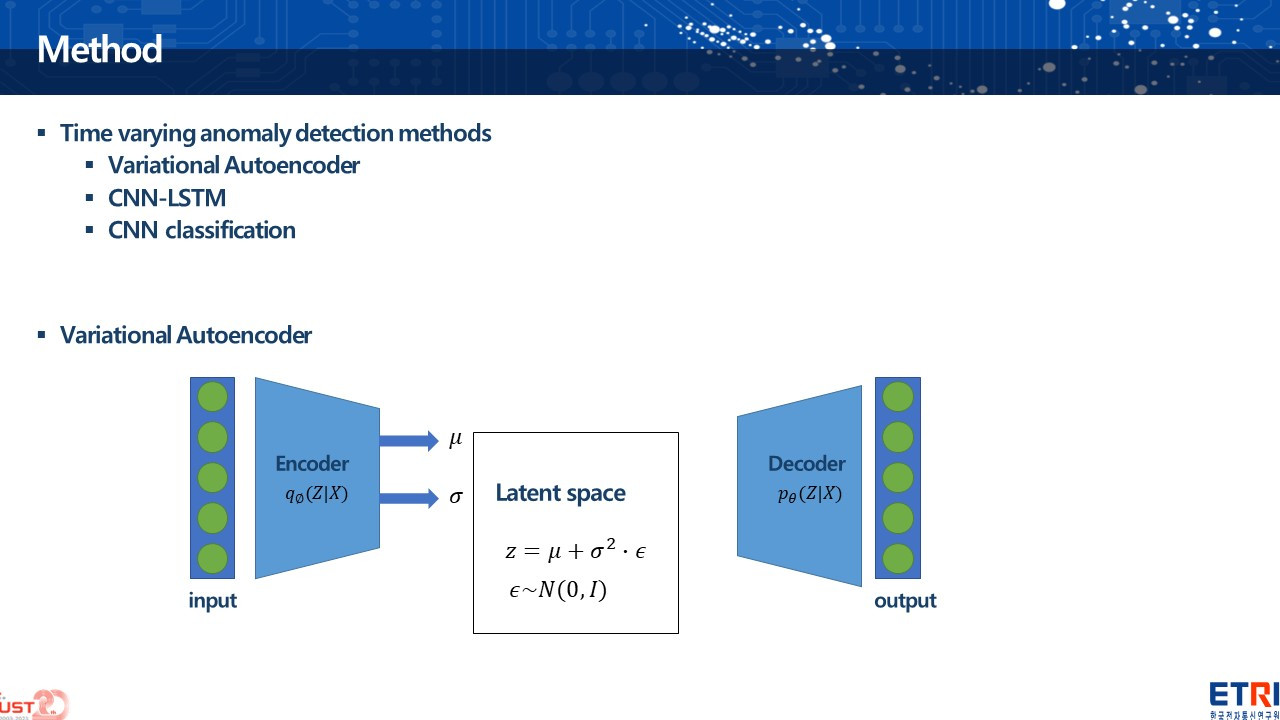
Variational Autoencoder: A generative model that learns to encode input data into a lower-dimensional latent space and then decode it back to the original dimensionality with the goal of capturing the most salient features of the data.
CNN-LSTM: A combination of Convolutional Neural Networks (CNNs) and Long Short-Term Memory (LSTM) networks, likely used to capture both spatial and temporal features in data.
CNN classification: A method that employs CNNs for feature extraction and classification tasks.
The diagram illustrates the VAE, which consists of two main components: an encoder that maps the input data to the latent space and a decoder that reconstructs the data from the latent space. The encoder produces two outputs for each input: a mean (µ) and a standard deviation (σ), which are used to sample from the latent space assuming a normal distribution (ε~N(0,I)). This sampled point is then fed into the decoder to generate the output, which is the reconstruction of the original input. This process allows the VAE to not only learn the most essential features but also to generate new data by sampling from the latent space. |
 IEEE/ICACT20240043 Slide.09
[Big Slide]