 |
Methodology
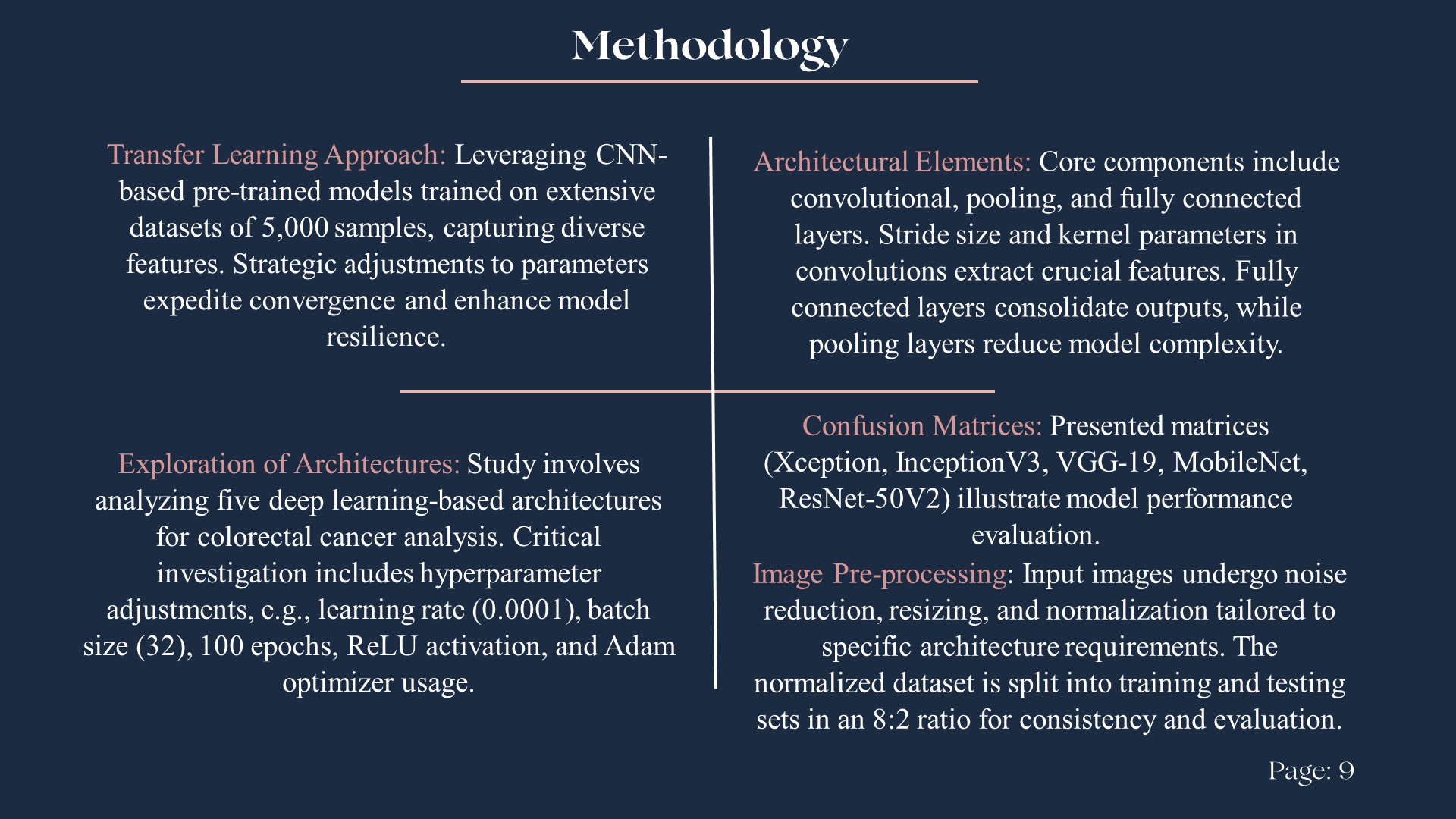
=> Transfer Learning Approach: Leveraging CNN-based pre-trained models trained on extensive datasets of 5,000 samples, capturing diverse features. Strategic adjustments to parameters expedite convergence and enhance model resilience.
=> Architectural Elements: Core components include convolutional, pooling, and fully connected layers. Stride size and kernel parameters in convolutions extract crucial features. Fully connected layers consolidate outputs while pooling layers reduce model complexity.
=> Exploration of Architectures: The study involves analyzing five deep learning-based architectures for colorectal cancer analysis. The critical investigation includes hyperparameter adjustments, e.g., learning rate (0.0001), batch size (32), 100 epochs, ReLU activation, and Adam optimizer usage.
=> Confusion Matrices: Presented matrices (Xception, InceptionV3, VGG-19, MobileNet, ResNet-50V2) illustrate model performance evaluation.
=> Image Pre-processing: Input images undergo noise reduction, resizing, and normalization tailored to specific architecture requirements. The normalized dataset is split into training and testing sets in an 8:2 ratio for consistency and evaluation.
|
 IEEE/ICACT20240405 Slide.09
[Big Slide]