 |
This gives us our first possibility:
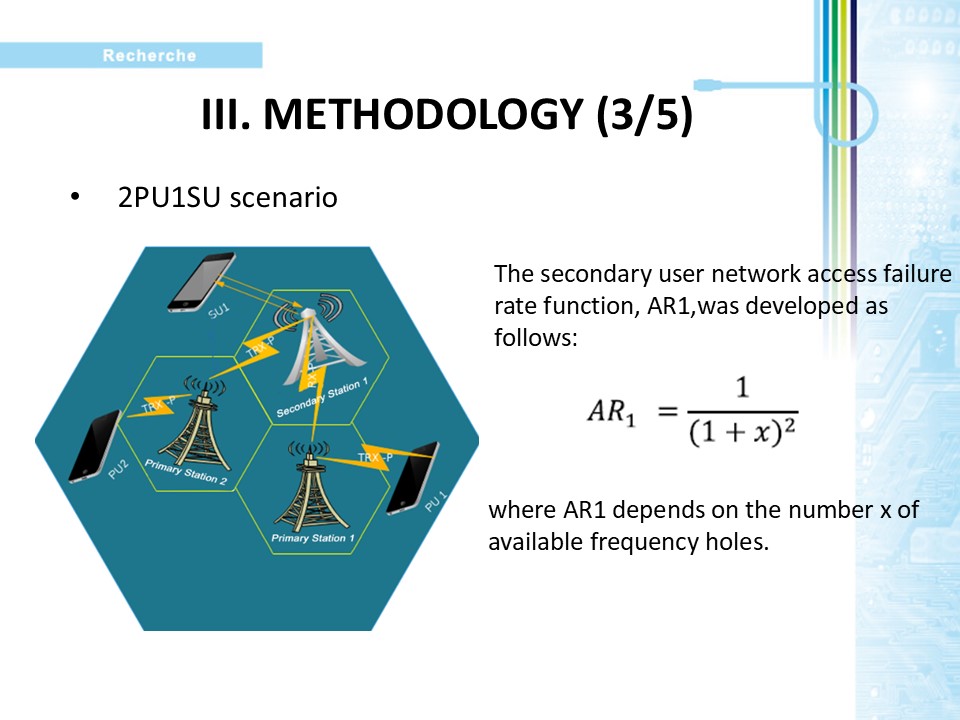
In this scenario, we consider an architecture with two neighboring primary stations, each operating on a licensed frequency, and a secondary station neighboring the two primary stations.
In this architecture, the secondary SB opportunely uses the holes available on each of the frequencies of the two primary SBs to transmit its SU's communications.
In this way, one frequency is saved out of three used in an architecture consisting of just three primary SBs.
In this scenario, this formula gives the failure rate as a function of the number of license frequencies used to make a call and the number x of available frequency holes.
AR1 is The secondary user network access failure rate function.
And AR1 depends on the number x of availabl frequency holes.
In this case x can only be less than or equal to one
(x inferior or equal to 1)
|
 IEEE/ICACT20250130 Slide.09
[Big Slide]