 |
Next, let me introduce some common communication countermeasure tactics.
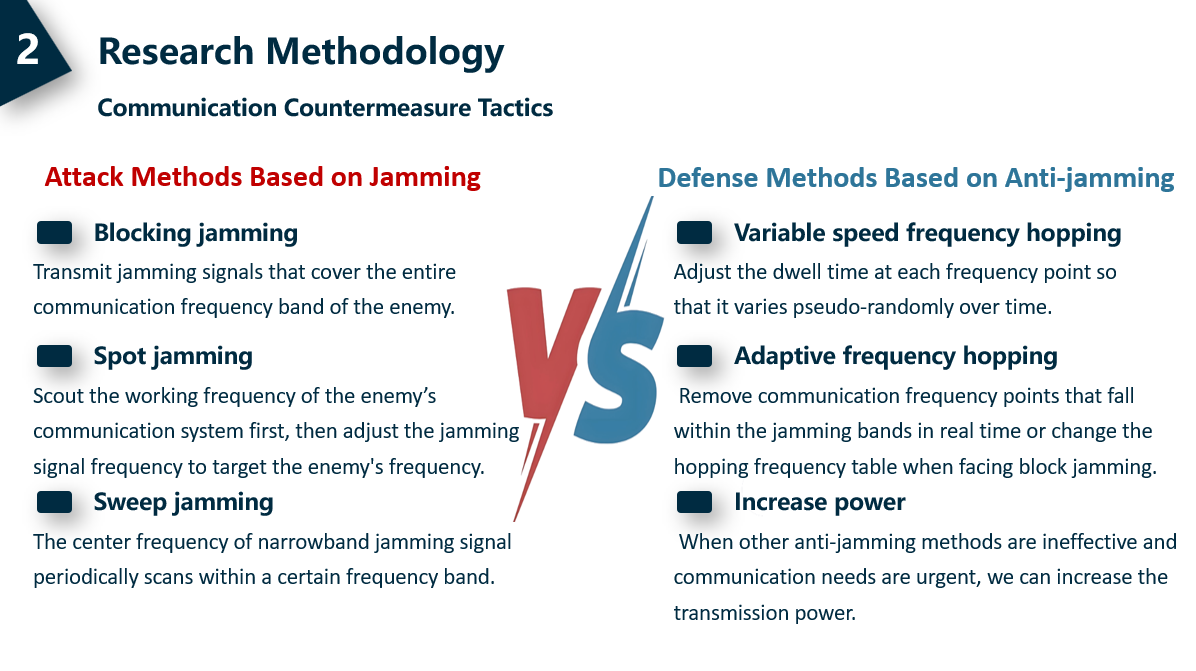
Based on the spectral width of the jamming signals, we divide the attack methods into 3 types: blocking jamming, spot jamming and sweep jamming.
Blook jamming transmits jamming signals that cover the entire communication frequency band of the enemy. The method is relatively simple, as it does not require precise knowledge of the enemy¡®s communication frequency. But the power density within the bandwidth is low, resulting in weaker jamming intensity¡£
Spot jamming first scouts the working frequency of the enemy¡¯s communication system , then adjust the jamming signal frequency to target the enemy's frequency. The jamming power of spot jamming is concentrated, resulting in high power utilization and good jamming results. However, it has high requirements for frequency reconnaissance and targeting
In sweep jamming, the center frequency of narrowband jamming signal periodically scans within a certain frequency band. It is more difficult to filter out compared to other jamming methods.
As for defense methods, common ones include variable speed frequency hopping, adaptive frequency hopping and increase power.
Variable speed frequency hopping adjusts the dwell time at each frequency point so that it varies pseudo-randomly over time.
Adaptive frequency hopping removes communication frequency points that fall within the jamming bands in real time or change the hopping frequency table when facing block jamming.
When other anti-jamming methods are ineffective and communication needs are urgent, we can increase the transmission power.
|
 IEEE/ICACT20250175 Slide.09
[Big Slide]
[YouTube]