 |
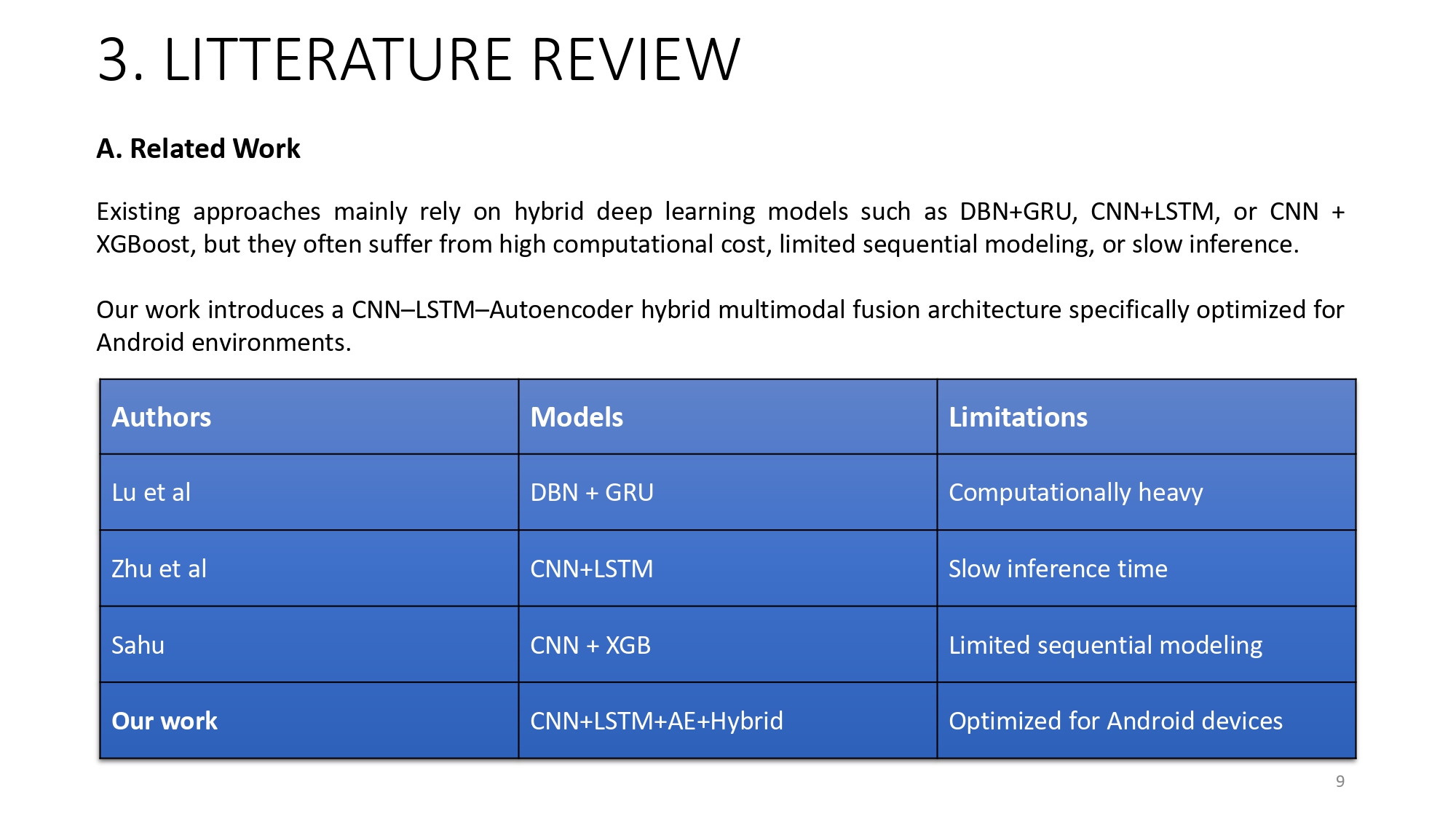
Existing research on Android malware detection primarily relies on hybrid deep learning approaches that combine multiple models to improve classification performance. Lu et al. proposed the integration of Deep Belief Networks (DBN) with Gated Recurrent Units (GRU) to capture both static and temporal characteristics; however, this approach remains computationally expensive and poorly suited for resource-constrained environments. Zhu et al. combined Convolutional Neural Networks with Long Short-Term Memory networks to model dynamic application behaviors, but their solution suffers from slow inference times. In contrast, Sahu et al. employed a CNN combined with XGBoost, achieving effective static feature classification while exhibiting limited capability in modeling sequential dependencies. To address these limitations, our work introduces a CNN–LSTM–Autoencoder hybrid multimodal fusion architecture specifically optimized for Android environments, achieving a better balance between detection accuracy, computational efficiency, and deployability. |
 IEEE/ICACT20260079 Slide.09
[Big Slide]
[YouTube]