 |
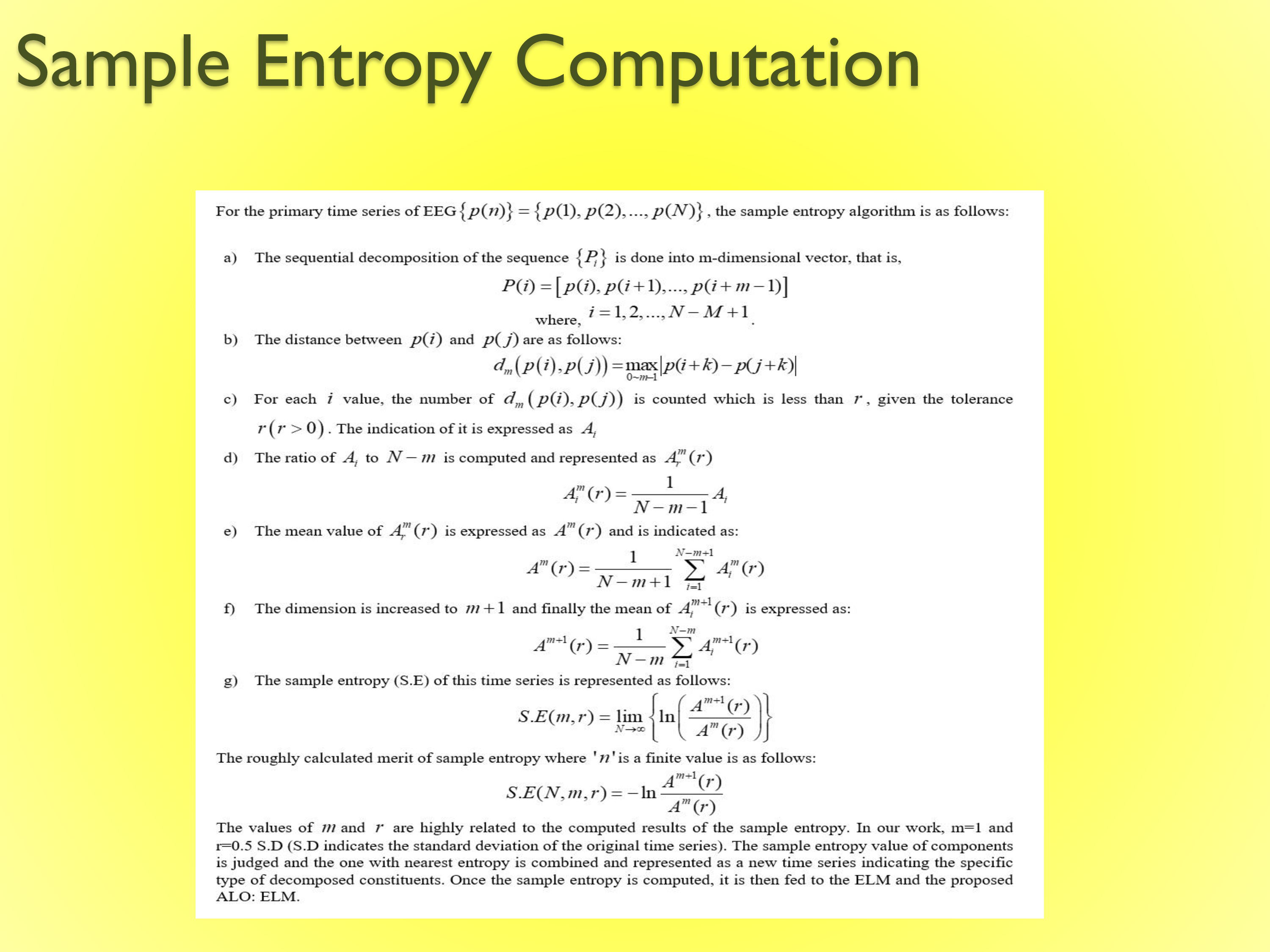
Sample entropy (SampEn; more appropriately K_2 entropy or Takens–Grassberger–Procaccia correlation entropy) is a modification of approximate entropy (ApEn; more appropriately "Procaccia–Cohen entropy"), used for assessing the complexity of physiological and other time-series signals, diagnosing e.g. diseased states. SampEn has two advantages over ApEn: data length independence and a relatively trouble-free implementation. Also, there is a small computational difference: In ApEn, the comparison between the template vector (see below) and the rest of the vectors also includes comparison with itself. Consequently, it is always possible to take a logarithm of probabilities. Because template comparisons with itself lower ApEn values, the signals are interpreted to be more regular than they actually are. These self-matches are not included in SampEn. |
 IEEE/ICACT20260121 Slide.09
[Big Slide]