 |
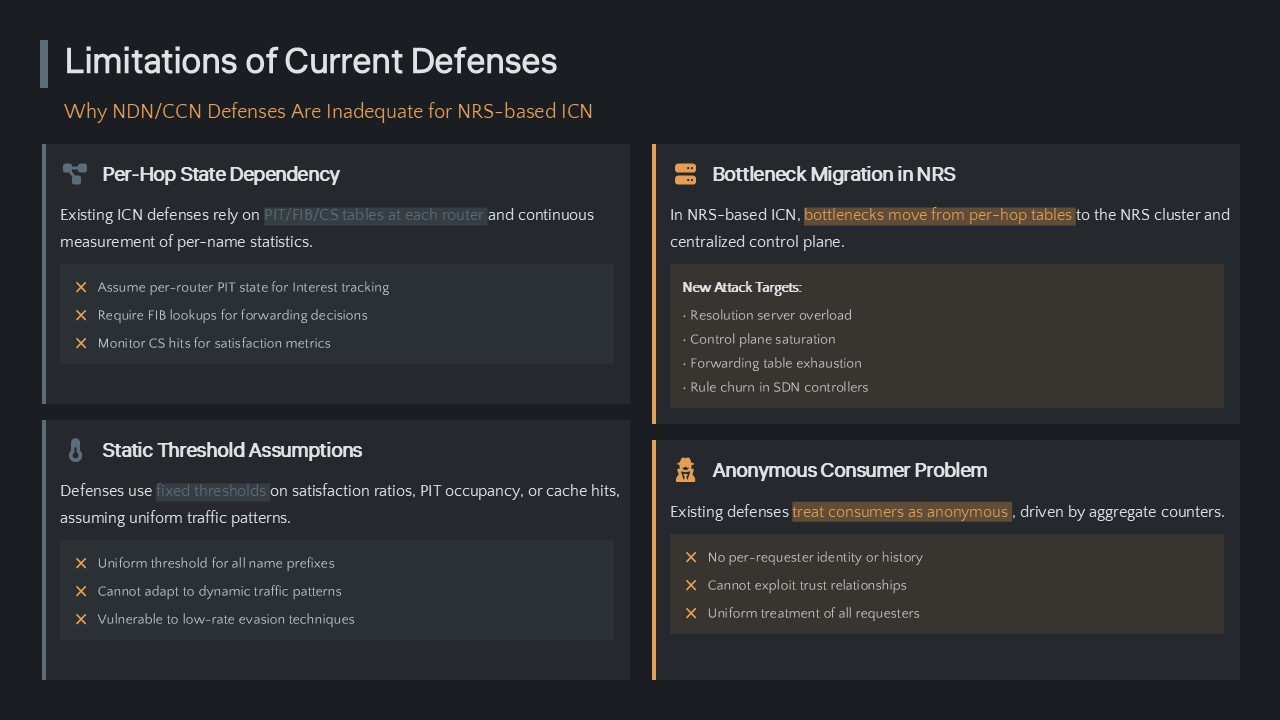
This slide explains why existing ICN defenses are inadequate for our setting.
First, many defenses depend on per-hop state, like PIT, FIB, and CS tables, and continuous measurement of per-name statistics at each router. In NRS-based ICN, forwarding nodes do not necessarily maintain the same fine-grained per-name counters, because resolution is delegated to NRS.
Second, many approaches rely on static thresholds, such as fixed satisfaction ratio thresholds. Static thresholds are fragile under dynamic traffic patterns and can be evaded by low-rate attacks.
Third—and most importantly—bottlenecks migrate in NRS-based ICN. The main targets become the NRS cluster and the control plane that installs forwarding rules. So hop-by-hop defenses are difficult to port directly.
Finally, existing defenses often treat consumers as effectively anonymous, driven by aggregate counters, which prevents the system from exploiting long-lived, per-requester trust history. |
 IEEE/ICACT20260343 Slide.09
[Big Slide]
[YouTube]