 |
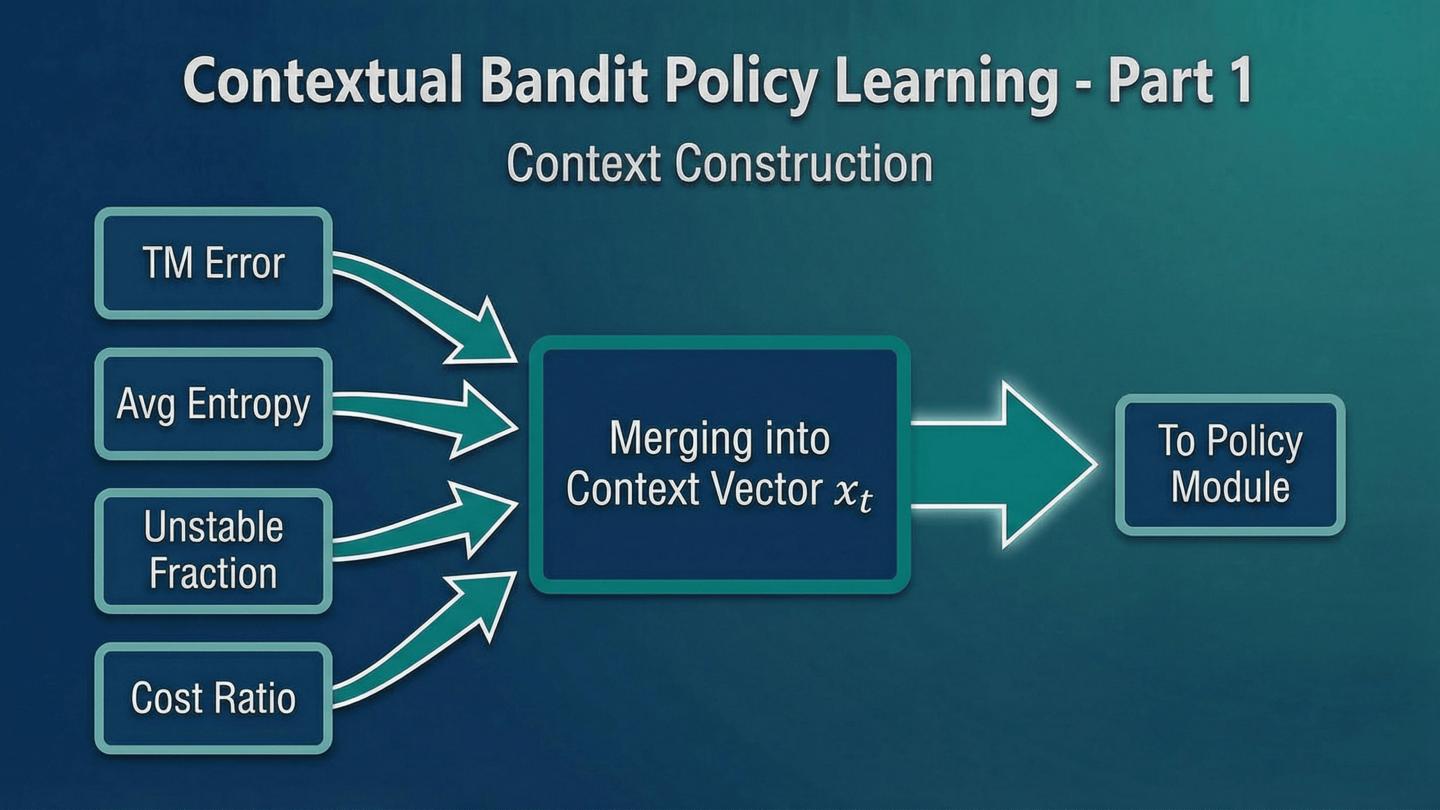
"Lets look at the policy framework that decides the overall monitoring strategy. We model the monitoring decision as a contextual bandit problem. This is far more flexible than using fixed heuristics because it allows the system to learn the optimal strategy through continuous interaction. The core idea is that we selected from a finite set of monitoring templates, or arms, each representing a different strategy—for example, an aggressive template that probes frequently versus a conservative one. At every decision epoch, BRIGHT constructs a context vector that captures the current network state. This context includes things like the recent traffic-matrix error, the average flow uncertainty we just discussed, and the current monitoring cost. Given this context, the policy module uses Thompson sampling to select the template that is predicted to yield the highest reward. This approach naturally balances exploration—trying out new templates—with exploitation—sticking to the best-performing template. The system learns a linear mapping from the network context to the expected reward for each template, ensuring that our monitoring strategy adapts dynamically to changing network conditions. But for this learning to work, we need a well-designed reward signal." |
 IEEE/ICACT20260358 Slide.09
[Big Slide]
[YouTube]