 |
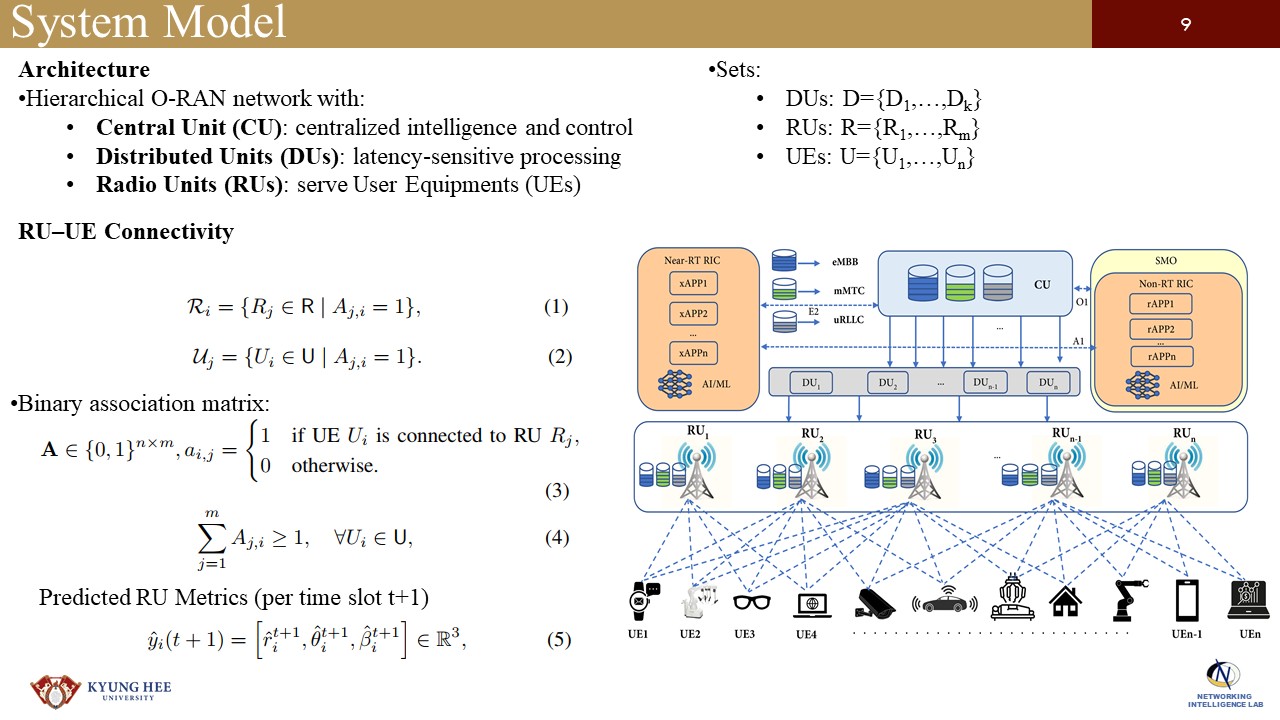
We consider a hierarchical O-RAN system consisting of one central unit (CU), multiple distributed units (DUs), and multiple radio units (RUs) that jointly serve a set of user equipments (UEs). Each UE can be connected to one or more RUs through a dynamic association matrix that captures multi-connectivity and may change over time. For every time slot, each RU is characterized by its resource block usage, throughput, and block error rate, which are predicted for the next slot. Using these predictions, the network adaptively steers UE traffic toward the most suitable RU–DU paths, enabling more efficient resource utilization while improving overall throughput and reliability.
|
 IEEE/ICACT20260367 Slide.09
[Big Slide]