 |
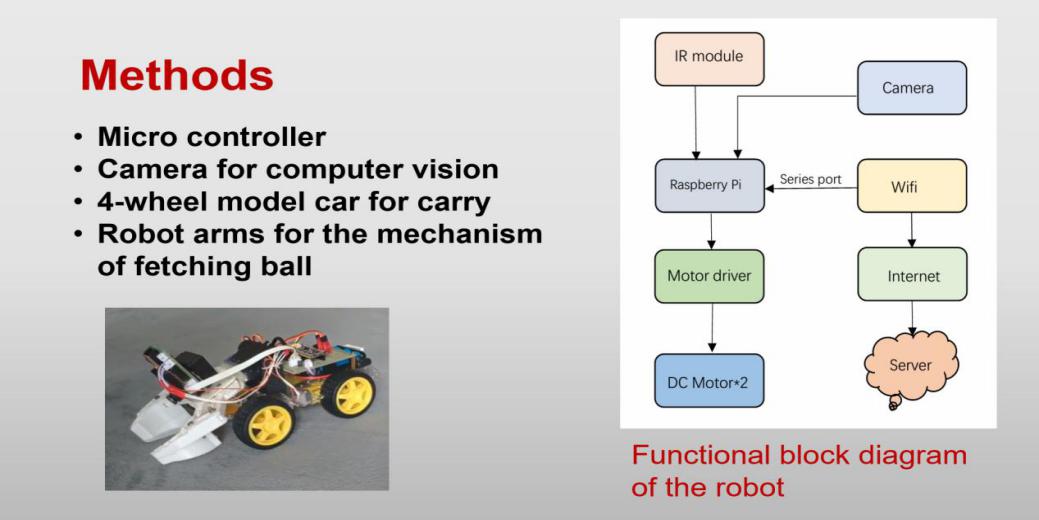
The functional block diagram of the robot for fetch-and-carry balls is presented in Fig. 2. The devices are introduced as follows,
A. Micro controller
Raspberry Pi systems-on-chip was employed to be the central processor of the robot. The Raspberry Pi 4, with a quad-core ARM Cortex-A72 processor, full gigabit Ethernet, and available with 2, 4 or 8GB of RAM. The video controller can generate standard modern TV resolutions, such as HD and Full HD [10-15].
B. Camera for computer vision
The computer vision is based on the deep learning of the artificial neuron network [16-19]. The number of the picture for training is 2000. Some of the training samples are presented in Fig. 3. The server is TensorFlow provided by Alibaba Cloud. The computer vision in the TesorFlow has been implemented in deep learning to analysis more than 10,000 pictures. The camera of the robot is responsible for taking pictures and obtaining images of the training target and then connecting with the server in the Internet to upload the pictures. Some of the training results are embedded in the Raspberry Pi to recognize the balls. However, if some cases can not recognize the ball, it will sent to the TensorFlow provided by Alibaba Cloud for recognition and training.
C. 4-wheel model car for carry
2 tank-type tracked wheels with the motor drive module were employed for the movable carrier of the electric heating radiator. The carrier was controlled by the IO port of STM32 G0. The key chip of motor drive module was L298N which was functioned by dual H-bridge. The range of power supply is 5 to 35V (dc). The maximum output current is 2A (the instantaneous peak current is 3A), and the maximum output power is 25W. The speeds of the wheels were tuned by pulse width modulation (PWM) technology where the duty cycles of the driving pulses were modulated by timers.
D. Robot arms for the mechanism of fetching ball
The robot arms for mechanism for fetching ball were designed by 3D printing [20-21]. The arms with several jokes and the notches can fetch the ball very stably. The camera is located on the centre of the beginning of arms to catch a ball using the computer vision. This design is aimed at the easier control of the robot arms.
|
 IEEE/ICACT20210265 Slide.10
[Big Slide]