 |
Here, we have problems with existing routing.
A common issue in all of existing opportunistic routing protocols is that they do not consider shadowing.
This problem causes these protocols to overestimate communication performance.
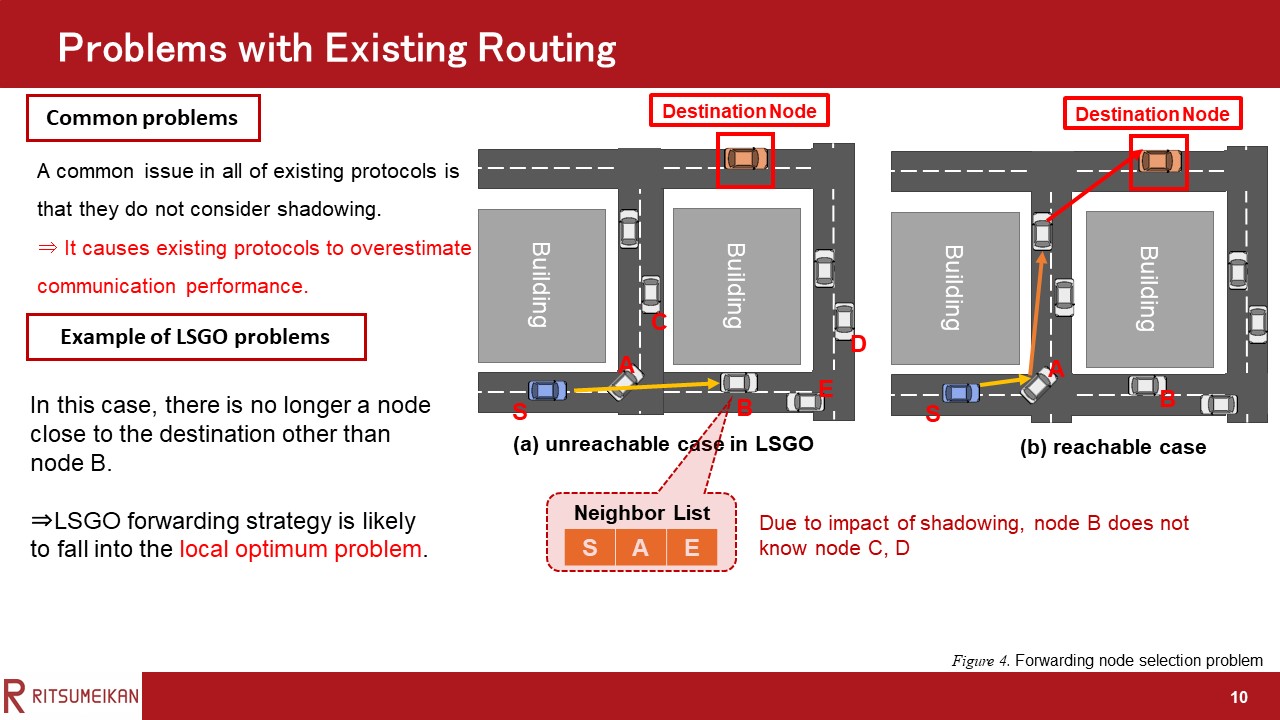
Let me use a figure to explain the example of LSGO problems.
In the forwarding strategy of LSGO, a node that is closer to the destination node and has better link quality is more likely to be selected as a forwarding node.
Consider the situation where node B is selected as the forwarding node, as shown in this Figure.
It is possible that the links with nodes C and D do not exist entirely because of shadowing in this case. In these cases, the problem is that there is no longer a node close to the destination other than node B. This has long been a problem in location-based routing protocols and is called the local optimum problem. From the above, we can see that the LSGO forwarding strategy is likely to fall into the local optimum problem and the local shadowing problem. This problem may be solved by selecting a street intersection node, such as node A, as a relay node, as shown in Figure 4 (b). |
 IEEE/ICACT20220087 Slide.10
[Big Slide]