 |
Our experiment specifically tested how a load-aware metric, called channel load metric or CLM, directed traffic across the network in the presence and absence of congested regions compared to the commonly used hop count based routing metrics.
To avoid the effects of performance anomalies exhibited by IEEE 802.11 devices in the presence of other wireless devices operating at different nominal bit rates all wireless nodes were set to operate at the basic rate of 1Mbps where routing and topology control packets are also transmitted. We also set the distance between devices such that the transmission range is within single hop.
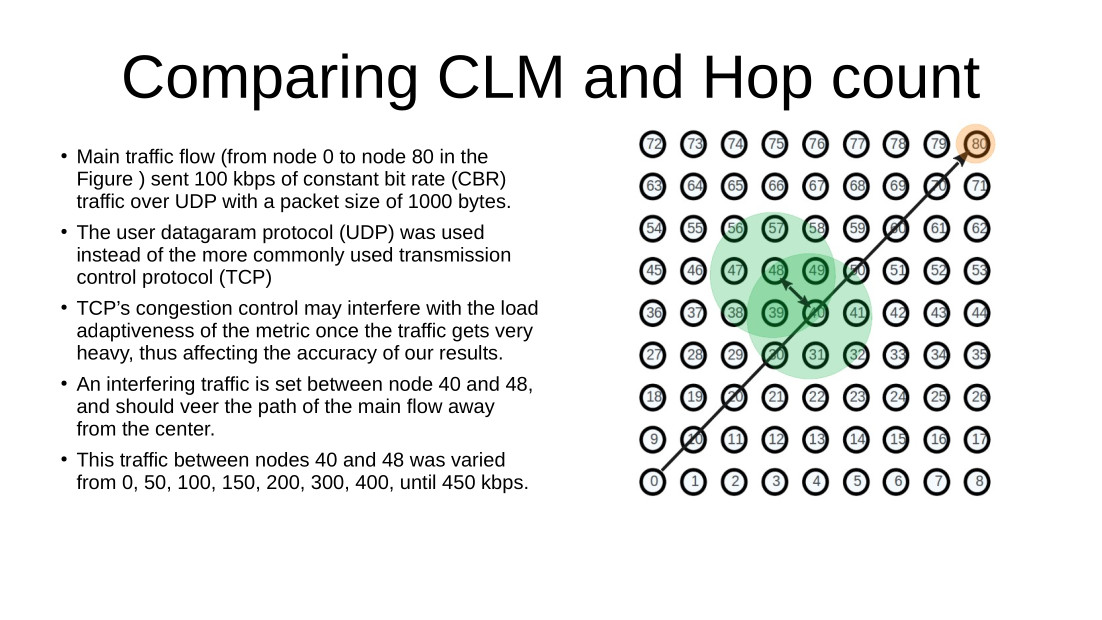
The main traffic flow (from node 0 to node 80 in the Figure) sent 100 kbps of constant bit rate (CBR) traffic over UDP with a packet size of 1000 bytes. The user datagaram protocol (UDP) was used instead of the transmission control protocol (TCP). TCP¡¯s congestion control may interfere with the load adaptiveness of the metric once the traffic gets very heavy, thus affecting the accuracy of our results.
Finally, an interfering traffic is set between node 40 and 48, and should veer the path of the main flow away from the center. This traffic between nodes 40 and 48 in the Figure varied from 0, 50, 100, 150, 200, 300, 400, until 450 kbps. |
 IEEE/ICACT20220402 Slide.10
[Big Slide]
[YouTube]