 |
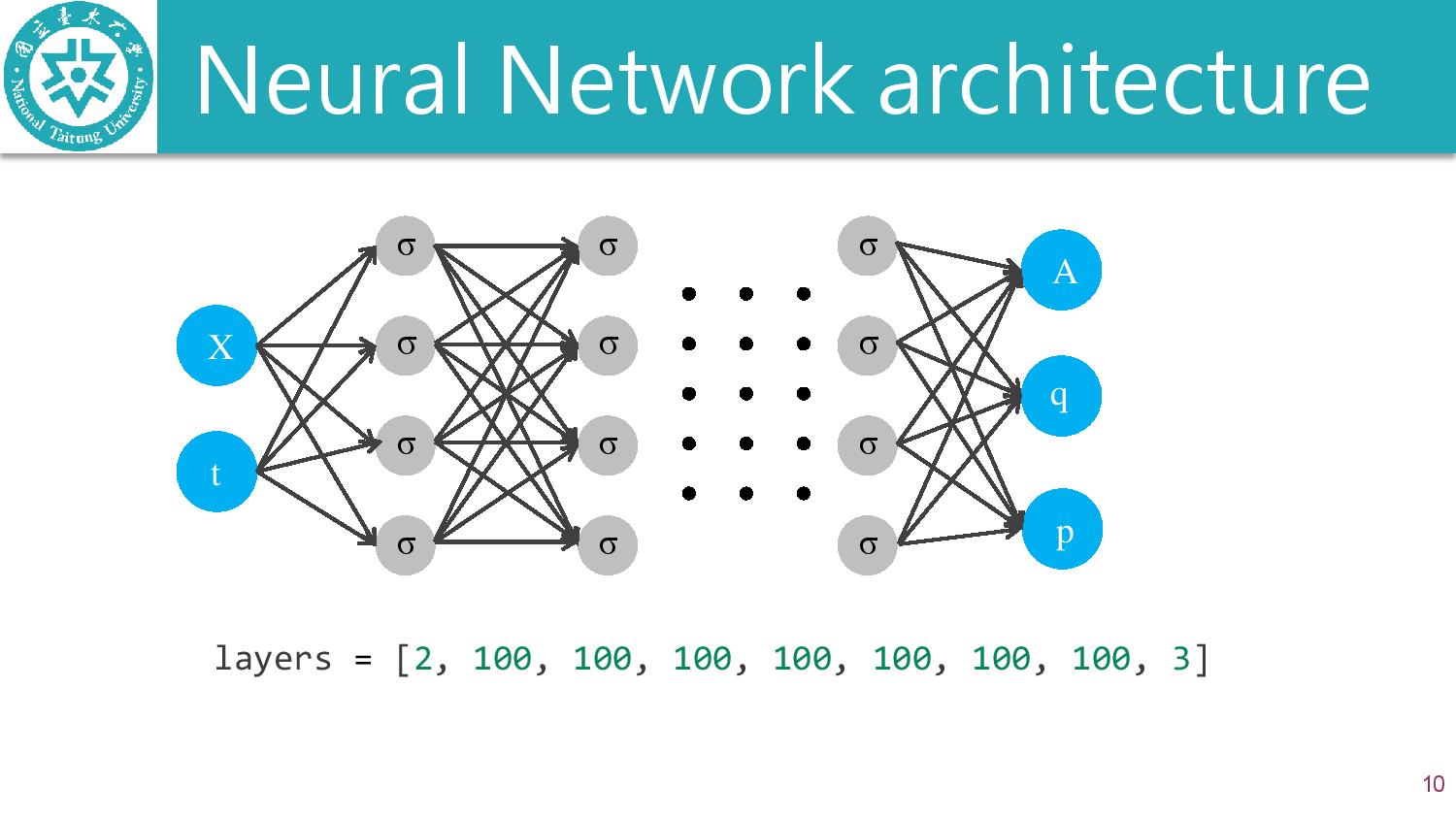
The problem is addressed by utilizing neural networks with seven hidden layers, each consisting of 100 neurons, and employing a hyperbolic tangent activation function.
This architecture has enough capacity to efficiently capture fine features in the propagating waveforms.
The neural networks take the scaled inputs [ ˆx, tˆ] and predict the non-dimensional outputs [A, u, p]
We are providing each neural network with velocity and cross-sectional area time series for one point at the inlet and the two outlets of the arterial network.
Using this data we infer the solution of 2, 000, randomly chosen collocation points, inside each domain, and = 1024 interface points. Moreover we choose batches of 1, 024 points as input and learning rate еч = 10−3 for the first 90, 000 iterations. Consequently, we set еч = 10−4 for the following 40, 000 for further minimizing the error and fine-tuning the neural network parameters.
|
 IEEE/ICACT20240208 Slide.10
[Big Slide]
[YouTube]