 |
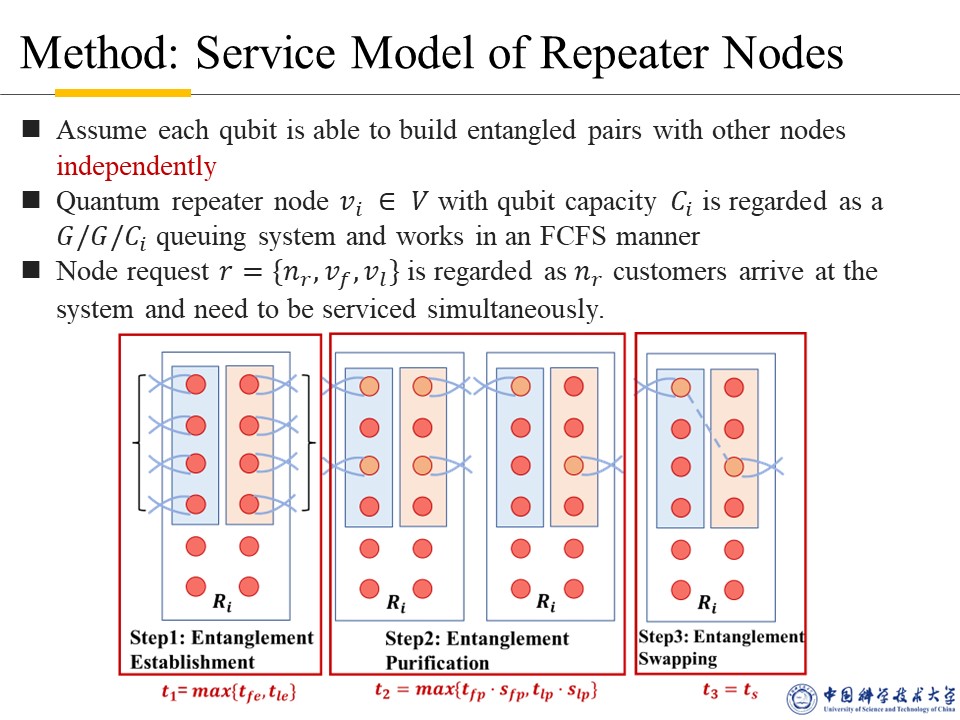
As mentioned earlier, quantum network nodes possess much less memory capacity compared with nodes in classical networks, resulting in severe resource contention under multi-request circumstances. It¡¯s likely for a newly arrived request to find all repeaters unavailable, making it necessary to distinguish the availability of those busy nodes.
Therefore, we model every quantum repeater node as a multi-server queuing system where both the arrival time and the service time of customers follow general distribution, and the number of servers is equal to the number of memory qubits in the node. Every node request r is regarded as 𝑛 sub 𝑟 customers arrive at the system and need to be serviced simultaneously. The graph shows the 3 stages of the request¡¯s service process with their time consumed in order.
|
 IEEE/ICACT20240378 Slide.10
[Big Slide]