 |
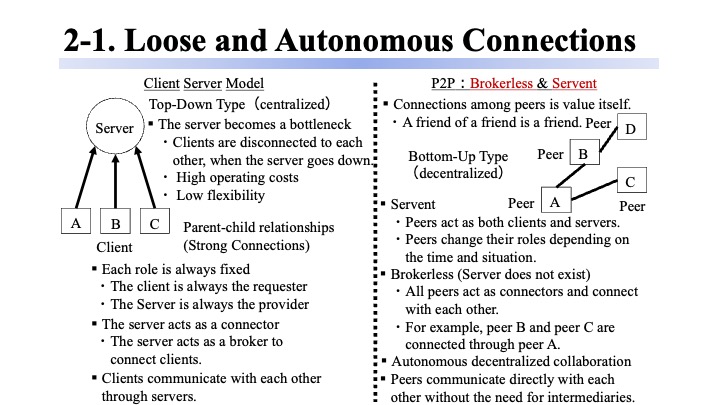
We explained the relationship between organizations and employees, and now we would like to describe this relationship in terms of the field of computer networks. By comparing P2P with traditional Client Server Model, we would like to explain 4 key points of P2P.
In Client Server Model, computers A, B, and C communicate with each other only through servers. In other words, there is a strong parent-child relationships, where the server acts as the parent and clients act as the children. As a result, this model has several issues: as the number of clients increases, the server¡¯s processing capacity decreases; if the server goes down, clients cannot connect to each other; and the cost of operating the server becomes a burden. The strong connections come with costs, making it difficult for new value to emerge. This Client Server Model is a centralized, Top-Down Type. In contrast, in P2P, server doesn¡¯t exist. Computers connect in a friend of a friend manner. For example, Computer B can connect to Computer C through Computer A. This P2P is a decentralized, Bottom-Up Type. In P2P, such a connection is called ¡°Brokerless¡±. Additionally, since server doesn¡¯t exist, all peers act as connectors and connect with each other. This is known as ¡°Servant.¡± These two concepts, ¡±Brokerless¡± and ¡±Servant,¡± are the first and second key points of P2P.
|
 IEEE/ICACT20250027 Slide.10
[Big Slide]