 |
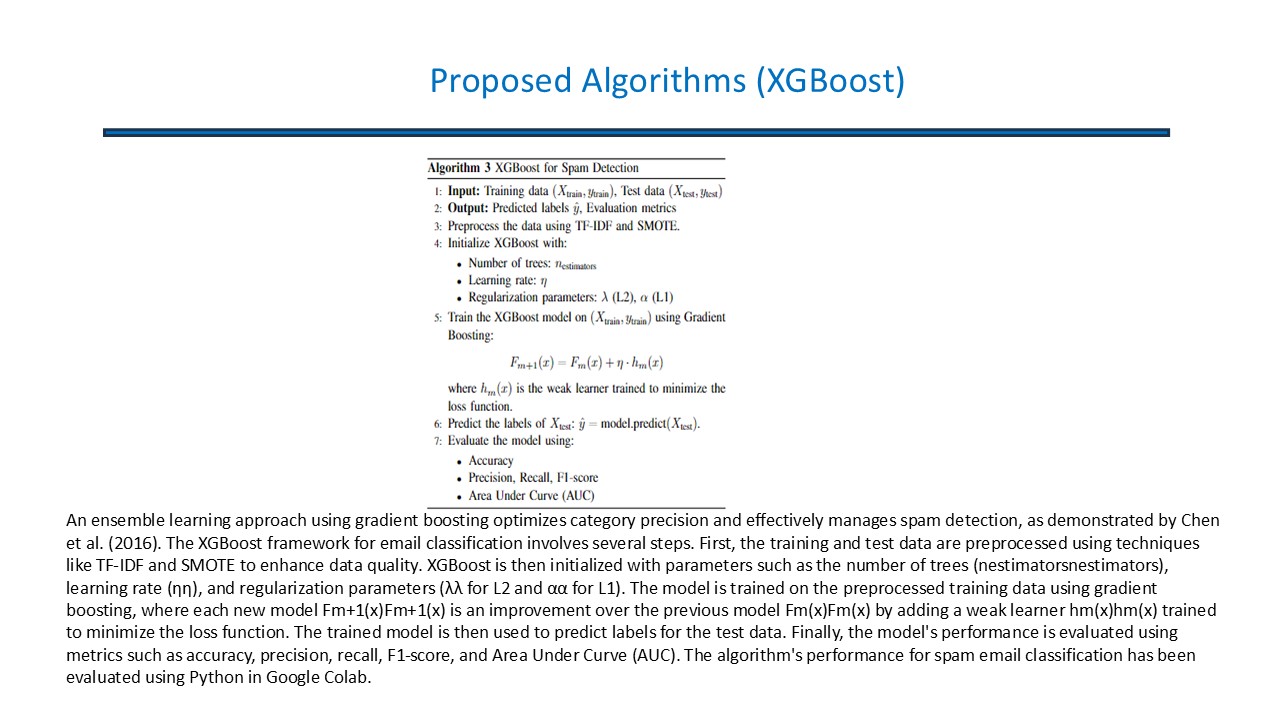
An ensemble learning approach using gradient boosting optimizes category precision and effectively manages spam detection, as demonstrated by Chen et al. (2016). The XGBoost framework for email classification involves several steps. First, the training and test data are preprocessed using techniques like TF-IDF and SMOTE to enhance data quality. XGBoost is then initialized with parameters such as the number of trees (nestimatorsnestimators), learning rate (ョョ), and regularization parameters (ルル for L2 and メメ for L1). The model is trained on the preprocessed training data using gradient boosting, where each new model Fm+1(x)Fm+1(x) is an improvement over the previous model Fm(x)Fm(x) by adding a weak learner hm(x)hm(x) trained to minimize the loss function. The trained model is then used to predict labels for the test data. Finally, the model's performance is evaluated using metrics such as accuracy, precision, recall, F1-score, and Area Under Curve (AUC). The algorithm's performance for spam email classification has been evaluated using Python in Google Colab.
|
 IEEE/ICACT20250220 Slide.10
[Big Slide]
[YouTube]