 |
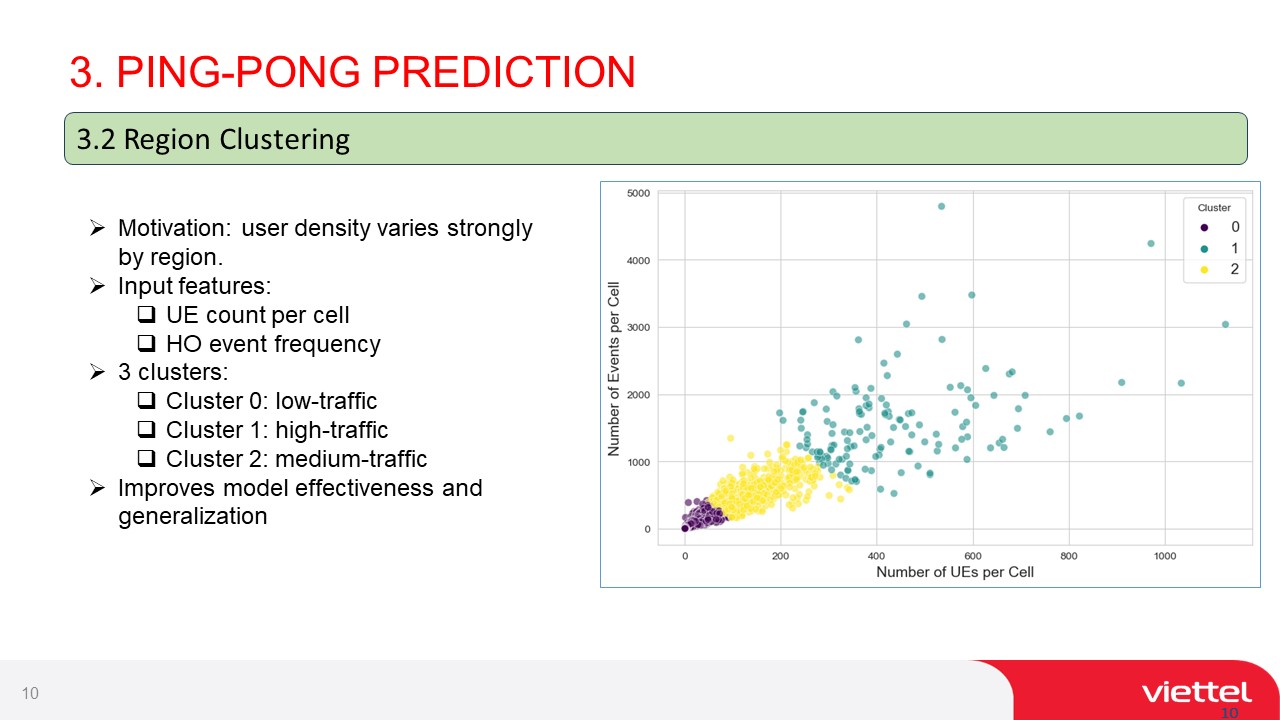
The motivation for region clustering stems from the fact that user density varies strongly by region. Some areas have high concentrations of users, while others are more sparsely populated.
To capture these regional characteristics, we use two input features:
The UE count per cell, which reflects the number of active users in each cells coverage area.
The handover event frequency, which indicates the mobility dynamics in each region.
Based on these features, we identify three distinct clusters:
Cluster 0 represents low-traffic regions with fewer UEs and lower handover frequency.
Cluster 1 contains high-traffic, dense urban areas with many UEs and frequent handovers.
Cluster 2 captures medium-traffic suburban regions.
By incorporating these region clusters into our model, we can improve its effectiveness and generalization. The model learns to adapt its predictions based on the regional context, making it more accurate across diverse network environments.
|
 IEEE/ICACT20260091 Slide.10
[Big Slide]