 |
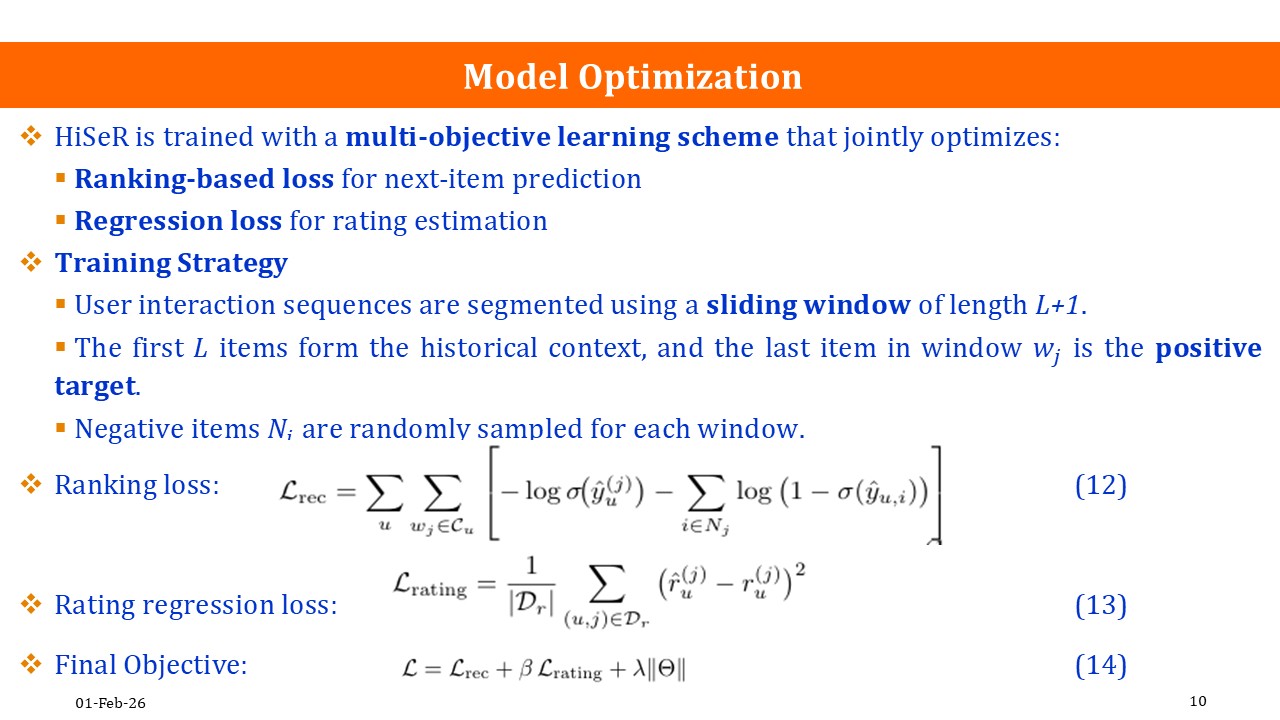
HiSeR is trained using a multi-objective learning scheme that jointly optimizes two goals: a ranking-based loss for next-item prediction and a regression loss for rating estimation. This joint optimization allows the model to leverage both implicit sequential behavior and explicit rating signals.
For each user, the interaction sequence is segmented into multiple sliding windows of length L plus one. In each window, the first L items serve as the historical context, while the last item is treated as the positive target. For every window, a set of negative items is randomly sampled to construct training instances.
As shown in Equation (12), the ranking loss encourages the model to assign a higher predicted score to the positive target than to negative items. This loss is defined using the sigmoid function, and it penalizes cases where negative items receive high relevance scores.
In addition to ranking, HiSeR also uses explicit ratings as auxiliary supervision. For each window with an observed rating, the model predicts a rating value, which is compared with the ground-truth rating. As shown in Equation (13), the rating regression loss is computed using the mean squared error over all valid user–item pairs with ratings.
Finally, we combine all objectives into a single loss function. As shown in Equation (14), the final training objective is a weighted sum of the ranking loss and the rating regression loss, together with งค2 regularization on the model parameters. The weighting coefficient controls the contribution of the rating prediction task. |
 IEEE/ICACT20260275 Slide.10
[Big Slide]