 |
In this experiment, the (k, n)-threshold scheme corresponding to (3, 5) is used in the proposed system.
The RSA algorithm is used to generate the secret key, whose key lengths are taken to be 128, 192, and 256 bits.
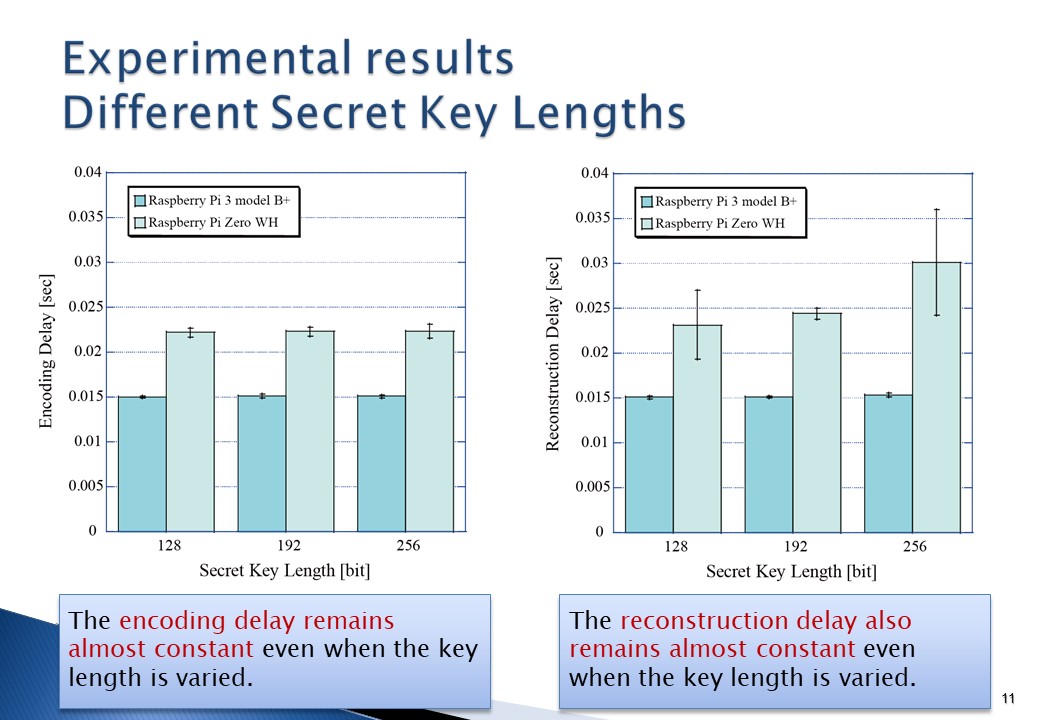
The figure on the left presents the encoding delay performances in the two scenarios.
The error bars in the figure capture the standard deviation corresponding to the 30 measurements.
As is evident from the figure, the encoding delay remains almost constant even when the key length is varied.
In the proposed system, the length of the secret key, S, does not affect the encoding delay significantly.
The encoding delay and the delay variance of the Raspberry Pi Zero WH board is observed to be greater than those of the Raspberry Pi 3 model B+ board owing to the lower CPU performance and smaller memory size of the former.
The figure on the right depicts the reconstruction delay performances in the two scenarios.
As in the case of encoding delay, the reconstruction delay of the Raspberry Pi 3 model B+ board is also observed to remain almost constant even when the key length is varied.
As the key length is increased, the reconstruction delay of the Raspberry Pi Zero WH board is observed to increase slightly.
The reconstruction delay and delay variance of the Raspberry Pi Zero WH board is greater than those of the Raspberry Pi 3 model B+ board.
|
 IEEE/ICACT20220056 Slide.11
[Big Slide]