 |
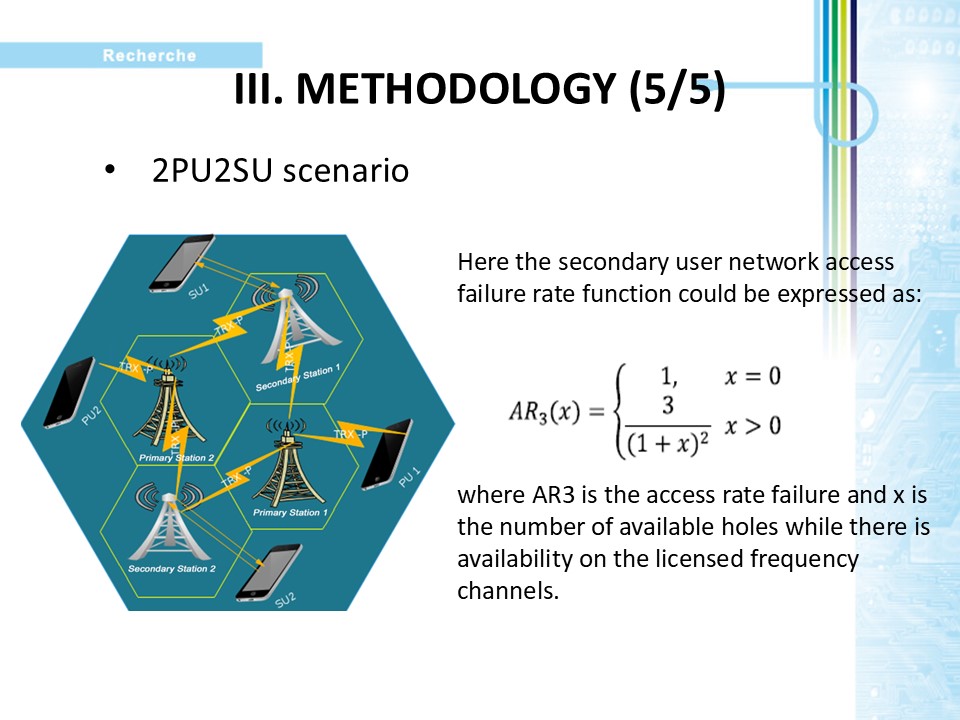
In this third scenario we consider an architecture with two neighboring primary base stations, each operating on a licensed frequency, and two secondary base stations neighboring the two primary base stations.
The two secondary base stations will use the holes available on each frequency of the two primary SBs, to transmit the communications.
This architecture saves two of the four frequencies that would be used if the architecture consisted solely of four primary SBs.
In this scenario, this formula calculates the call failure rate as a function of whether the two licensed frequencies are being used to make calls, or whether they are all busy or only one is free.
|
 IEEE/ICACT20250130 Slide.11
[Big Slide]