 |
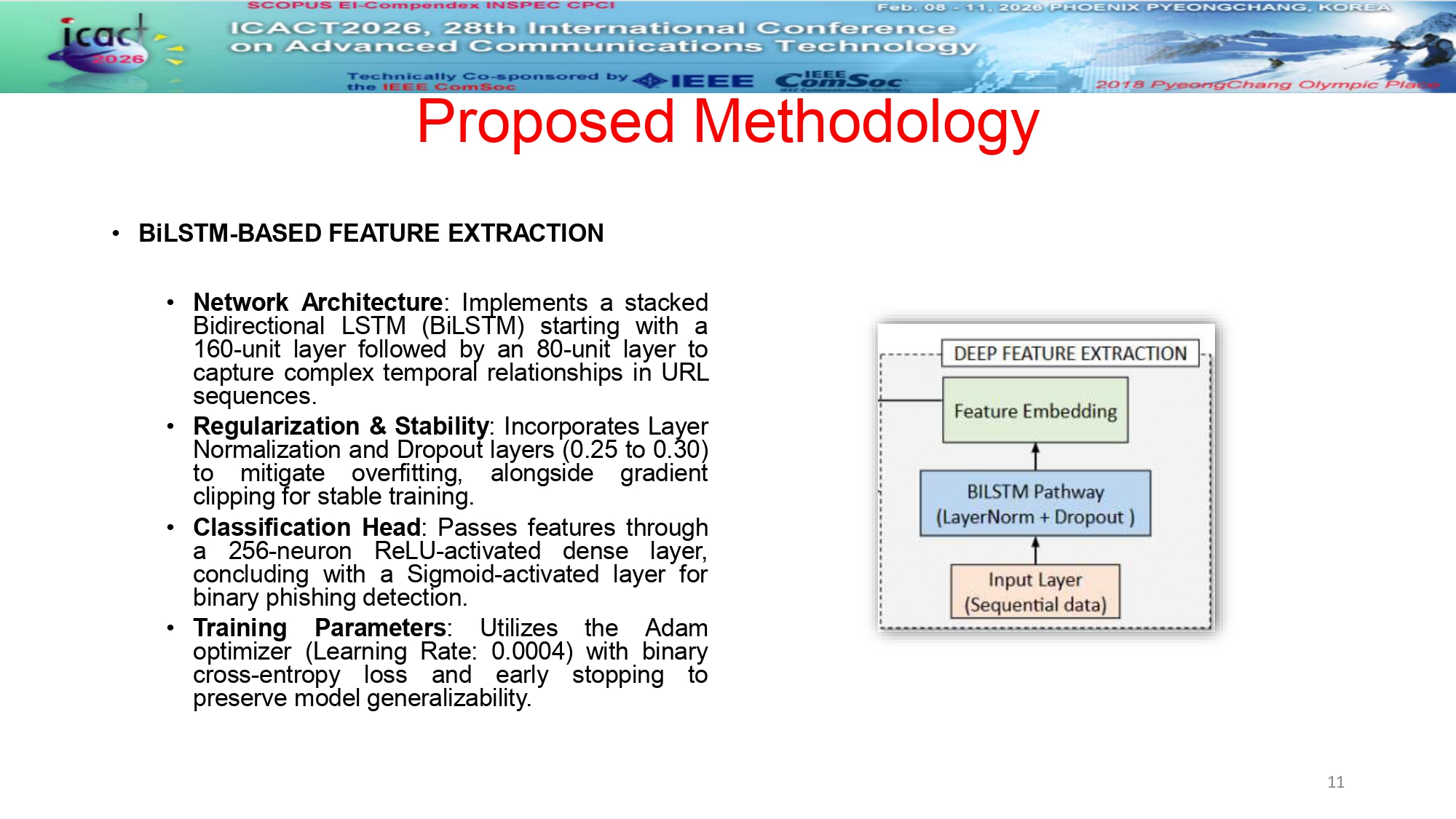
Once our features are selected, we pass them into the core of our deep learning model: a stacked Bidirectional LSTM architecture. Unlike standard LSTMs, this bidirectional approach allows the model to capture complex temporal relationships by looking at URL sequences from both the beginning and the end simultaneously.
WeĦŻve engineered this with a high-capacity 160-unit first layer, followed by an 80-unit second layer. To ensure the model doesnt just memorize the data, we integrated rigorous regularization, specifically Layer Normalization and Dropout layers ranging from 0.25 to 0.30. This is paired with gradient clipping to maintain absolute training stability. The extracted deep features are then processed through a 256-neuron ReLU-activated dense layer, concluding with a sigmoid-activated head for the final detection. We trained this using the Adam optimizer at a precise learning rate of 0.0004, utilizing early stopping to maximize our ability to generalize to new, unseen phishing threats. |
 IEEE/ICACT20260103 Slide.11
[Big Slide]
[YouTube]