 |
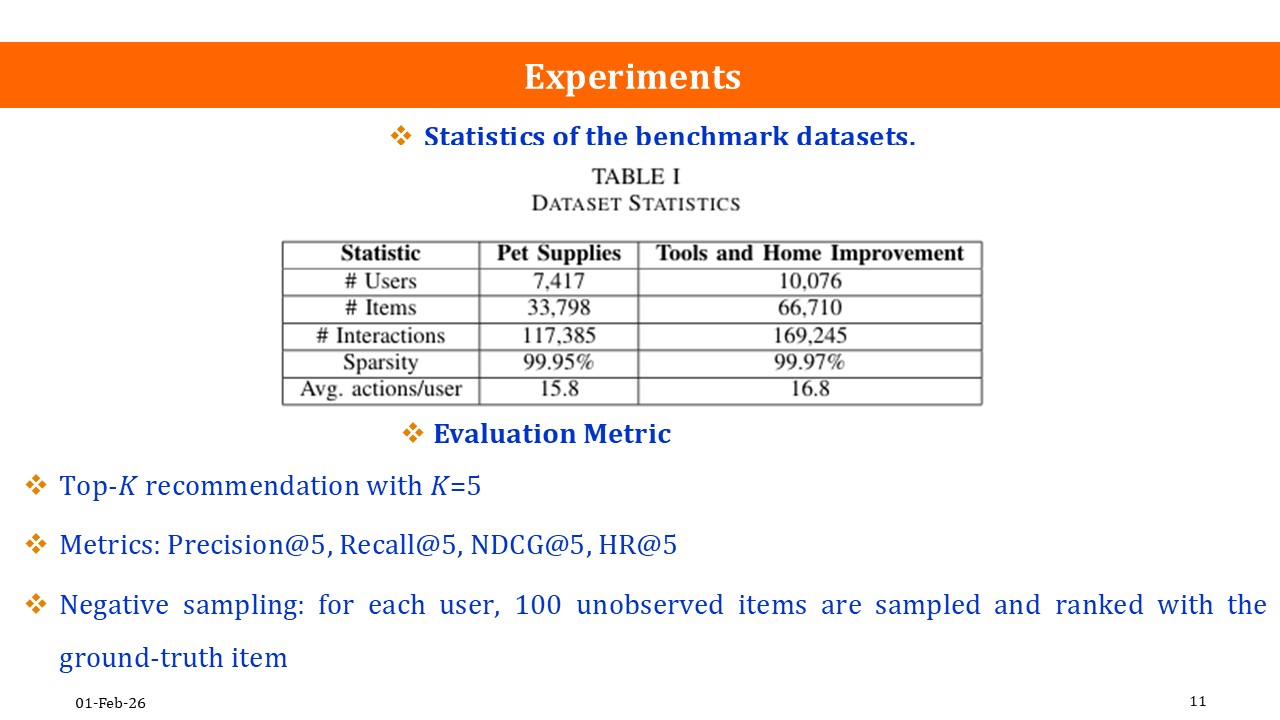
We conduct experiments on two Amazon Product Reviews datasets: Pet Supplies and Tools and Home Improvement, which represent two distinct types of consumer behavior. Each dataset contains user IDs, item IDs, timestamps, ratings, and review texts. Users with fewer than ten interactions are filtered out, and interactions are chronologically sorted to form user sequences. The data is split by time, with 70% for training and 30% for testing, preserving temporal order. Table 1 reports the dataset statistics, showing very high sparsity and an average of about 16 interactions per user.
We evaluate performance using Top-K recommendation with K equals 5. Four standard metrics are used: Precision@5, Recall@5, NDCG@5, and Hit Ratio@5, which measure both accuracy and ranking quality of the recommended items.
To reduce computational cost, we follow a standard negative sampling strategy. For each user, 100 unobserved items are randomly sampled as negatives and ranked together with the ground-truth item to compute the evaluation metrics. |
 IEEE/ICACT20260275 Slide.11
[Big Slide]