 |
Next, we determine the root node for timestamp compensation.
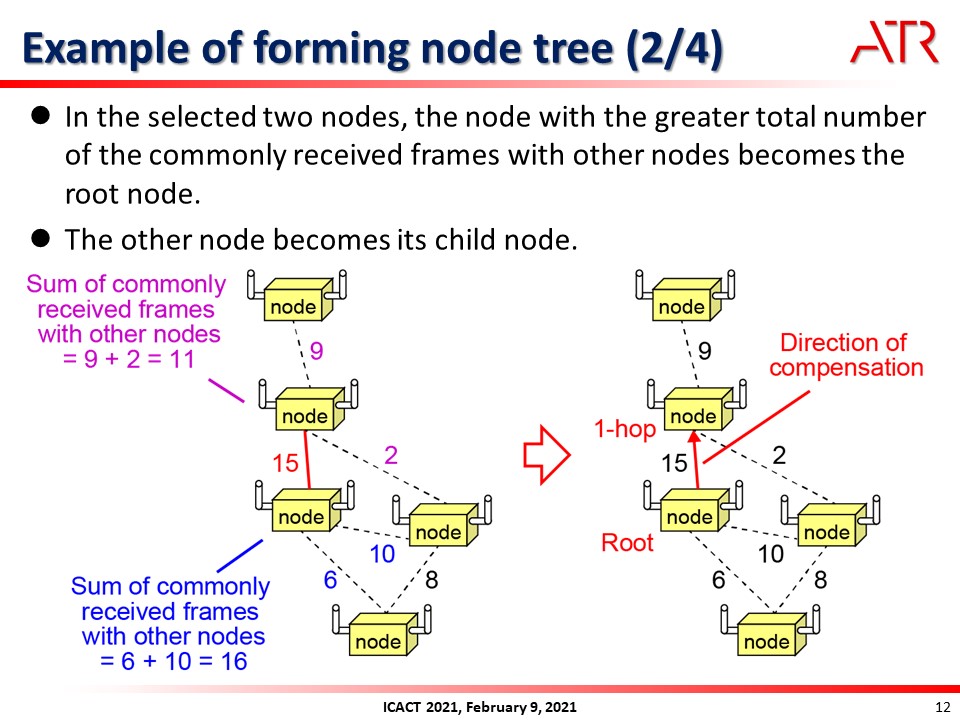
We choose the node with the node with the greater total number of the commonly received frames with other nodes as the root node from the selected two nodes, and the other node becomes its child node.
In this example, the upper node has 11 commonly received frames with other nodes. On the other hand, the lower node upper node has 16 commonly received frames with other nodes. So, the lower becomes the root node, and the timestamp compensation is performed in the direction of this arrow. |
 IEEE/ICACT20210244 Slide.12
[Big Slide]