 |
In the (k, n)-threshold scheme, it is reasonable to assume that both the encoding delay and the reconstruction delay increase when either n is constant, and k is increased, or k is constant and n is increased. Therefore, k and n are assumed to increase from (k, n) = (10,10) to (k, n) = (100,100) with k=n.
A 128-bit RSA secret key is used in this experiment.
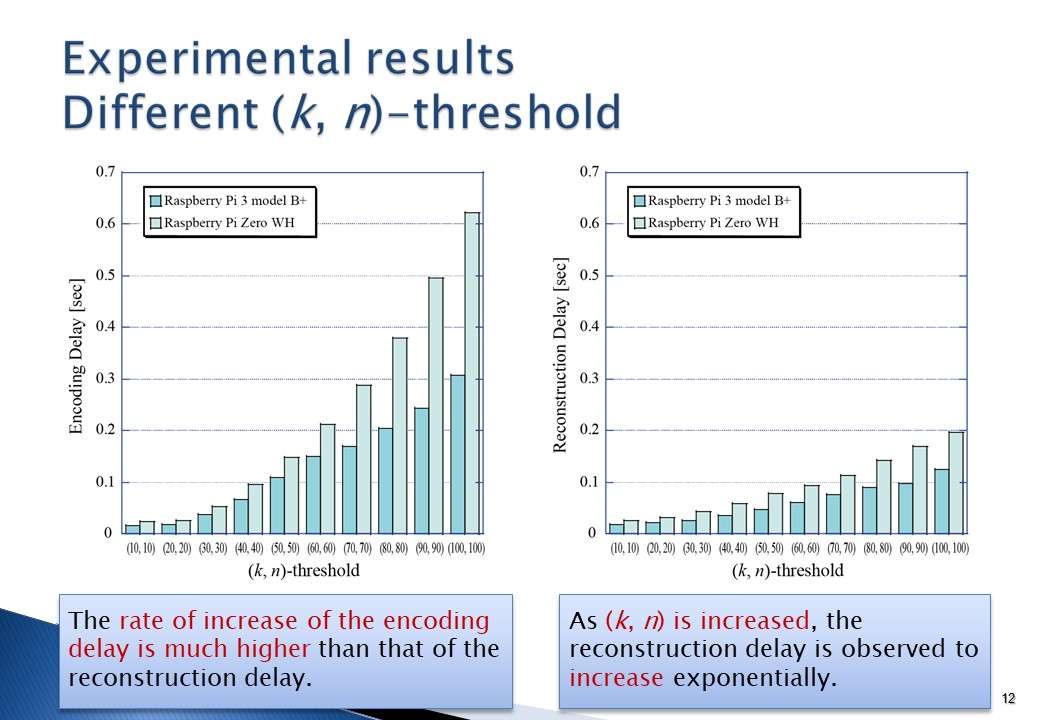
The figure on the left depicts the encoding delay performances in the two scenarios.
As (k, n) is increased, the encoding delay is observed to increase exponentially.
Compared to that of the Raspberry Pi 3 model B+ board, the rate of increase of the encoding delay of the Raspberry Pi Zero WH board is significantly higher due to its lower CPU performance and smaller memory size.
The figure on the right depicts the reconstruction delay performances in the two scenarios.
As in the case of encoding delay, the reconstruction delay is observed to increase exponentially as (k, n) is increased.
From these figures, it is evident that the rate of increase of the encoding delay is much higher than that of the reconstruction delay.
Therefore, determination of the values of (k ,n) based on the encoding delay is essential.
|
 IEEE/ICACT20220056 Slide.12
[Big Slide]