 |
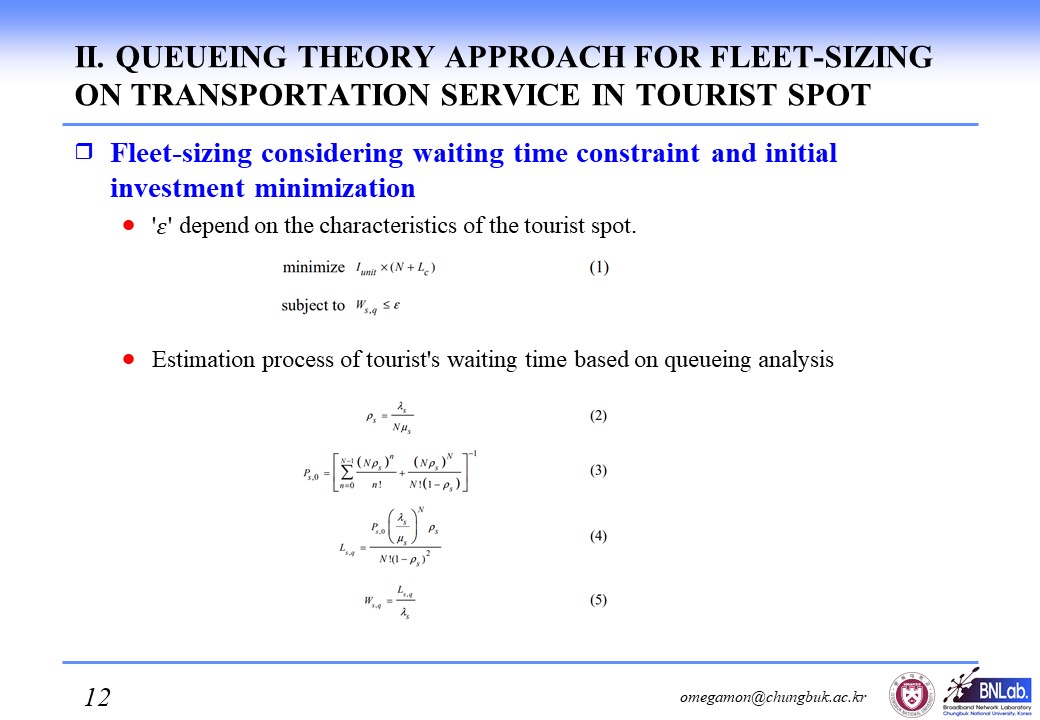
The optimization problem to minimize initial investment considering waiting time of service requester is formed as equation (1). Investment costs are determined by multiplying the number of autonomous electric vehicles by the unit price.
Unit investment of autonomous vehicle is noted ¡®I_unit ¡¯. Since the latency constraints represented by an ¡®¥å¡¯ vary depending on the characteristics of objective system, the suitable values for the system must be considered.
the customer¡¯s waiting time, W_q, can be estimated through equation (2) to (5).
By solving this optimization problem with corresponding arrival rate and service rate of targeting circumstance, a relationship between the number of service autonomous vehicle and waiting time of service requester is obtained. This relationship shows exponential decrease of customer¡¯s waiting time while the number of autonomous electric vehicles increase linearly. |
 IEEE/ICACT20220062 Slide.12
[Big Slide]