 |
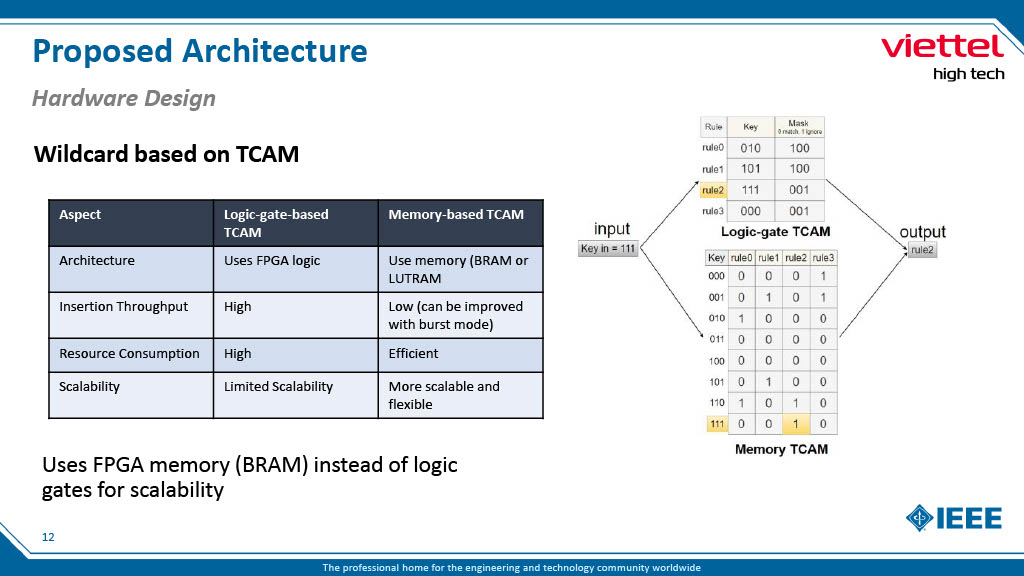
There are two main TCAM implementation methods: logic-gate-based and memory-based TCAM. In logic-gate-based TCAM, FPGA logic resources store and compare key-mask pairs, offering high insertion throughput but consuming significant resources as rule numbers increase. Memory-based TCAM uses memory like Block RAM or Lookup Table RAM to store keys and masks, offering better memory efficiency but lower insertion throughput. This can be improved with "burst" insertion mode. Memory-based TCAM is ideal for Wildcard Tables due to its lower resource usage and flexibility, making it suitable for scalable network systems. In the next section, I will present firmware architecture and interface between FPGA và firmware. |
 IEEE/ICACT20250056 Slide.12
[Big Slide]