 |
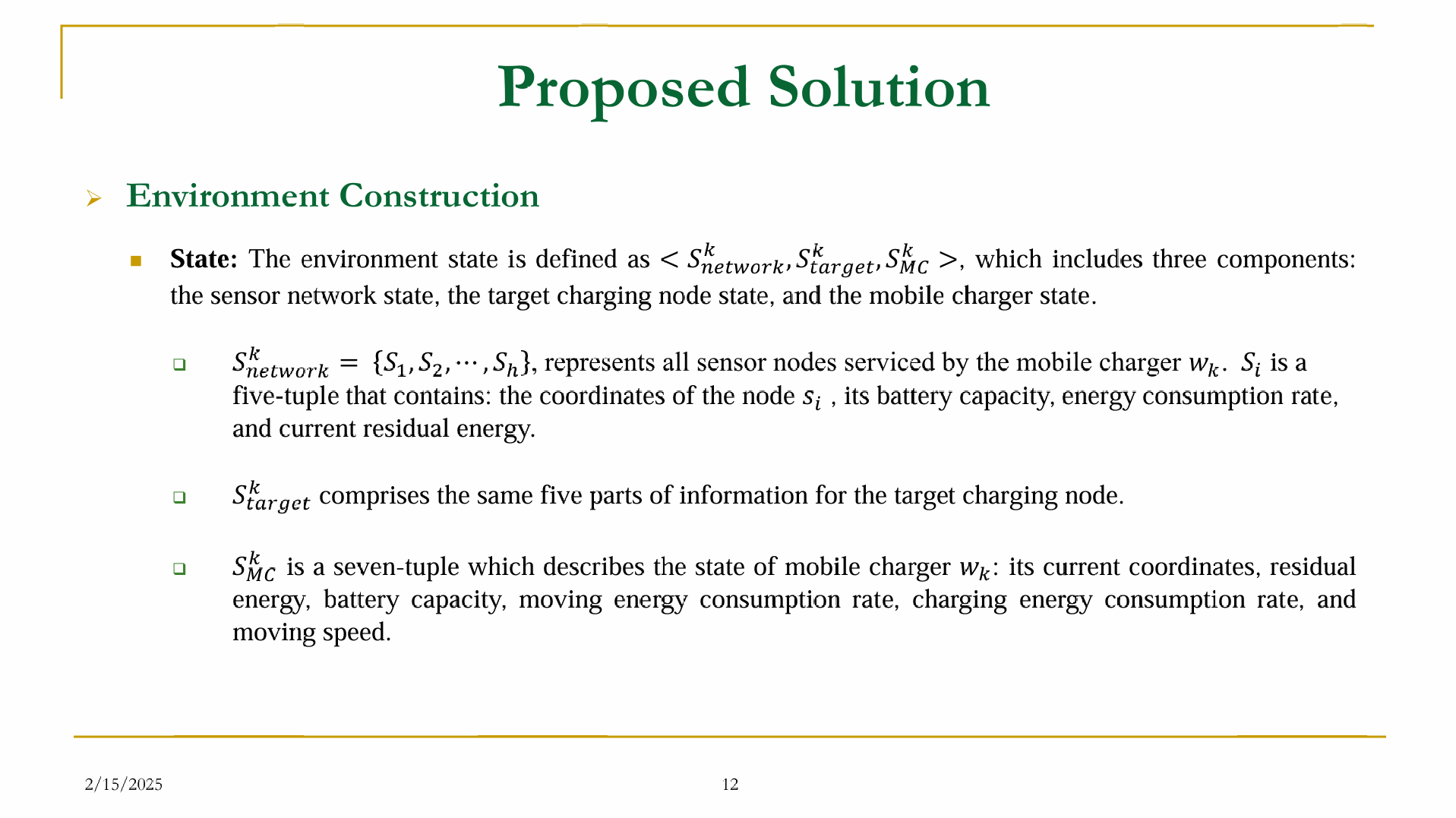
After selecting the target charging node, a mobile charger needs to schedule the charging duration at this chosen node. We propose a charging duration calculation algorithm based on deep reinforcement learning. The mobile charger is an agent that interacts with the environment. In this slide, we introduce how to construct a learning environment, including the state, action, and reward function for training the agent. State: The environment state, denoted as <𝑆_𝑛𝑒𝑡𝑤𝑜𝑟𝑘^𝑘, 𝑆_𝑡𝑎𝑟𝑔𝑒𝑡^𝑘, 𝑆_𝑀𝐶^𝑘>, comprises three components: the sensor network state, the target charging node state, and the mobile charger state. The sensor network state, represented as 𝑆_𝑛𝑒𝑡𝑤𝑜𝑟𝑘^𝑘={𝑆_1,𝑆_2,⋯,𝑆_ℎ }, encompasses all sensor nodes serviced by the mobile charger 𝑤_𝑘. 𝑺_𝒊 is a five-tuple that contains: the coordinates of the node 𝒔_𝒊 , its battery capacity, energy consumption rate, and current residual energy. 𝑆_𝑡𝑎𝑟𝑔𝑒𝑡^𝑘 comprises the same five parts of information for the target charging node. 𝑆_𝑀𝐶^𝑘 is a seven-tuple which describes the state of mobile charger 𝑤_𝑘: its current coordinates, residual energy, battery capacity, moving energy consumption rate, charging energy consumption rate, and moving speed.
|
 IEEE/ICACT20250091 Slide.12
[Big Slide]