 |
BPSK: pulse width is 10/31 mu s, encoding for [0,0,1,1,1,0,1,1,0,1,1,0,1,0,1,0,1,0,0,0,0,0,0,1,1,1,0,0,1,1,0], the initial phase of 0, the signal carrier frequency of 30 MHz.
CW: The pulse width is 20 レs, the carrier frequency is 30MHz, and the initial phase is 0.
LFM: The pulse width is 20 レs, the bandwidth is 10MHz, the starting frequency is 30 MHz, and the initial phase is 0.
MPSK: The subpulse width is 0.4 レs, Franck coding is used, the number of code elements is 5, the carrier frequency is 30 MHz, and the initial phase is 0.
NLFM: The asymmetric NLFM signal shown on Radar Manual is used, the frequential-time function and coefficient value are the same as in the literature[12], the pulse width is 20 レs, the bandwidth is 10 MHz, the starting frequency is 30 MHz, and the initial phase is 0.
In the simulation experiment, the number of antenna array elements 𝑀=5, the number of radars 𝐾=5, the signal amplitude is 1, the sampling frequency 𝐹𝑠=300 MHz, the number of signal sampling points 𝑁=605999, the signal-to-noise ratio of the observation signal after adding noise is 30 dB, and the blind source separation method adopts the SOBI method.
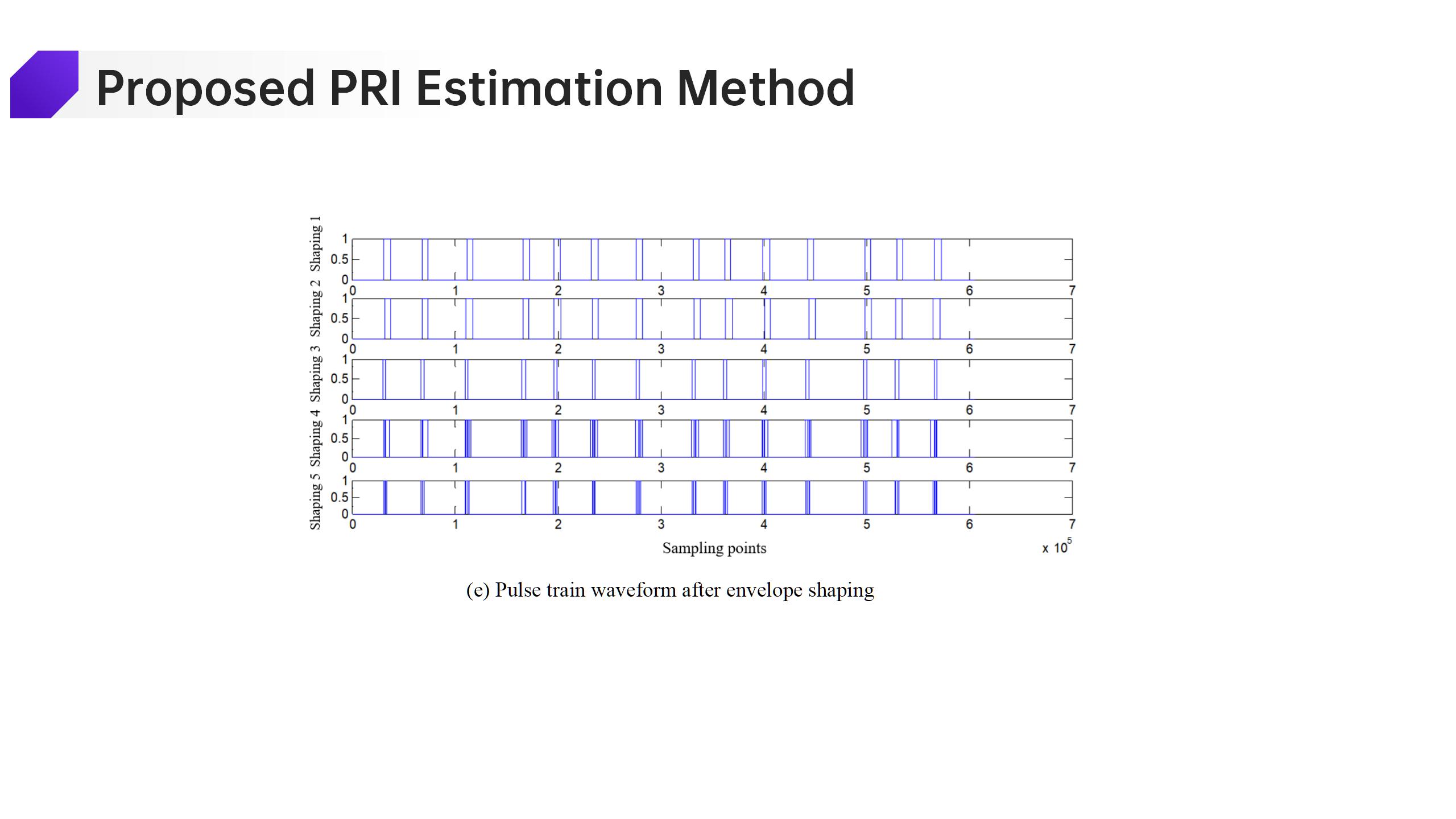
The waveform of each key link signal is shown in Figure 4. The similarity coefficients of the separated signals and radar emitter signals are shown in Table 1. The PRI parameters of the five radar emitter signals and the PRI parameter results calculated by separating the five signals are shown in Figure 5.
|
 IEEE/ICACT20250229 Slide.12
[Big Slide]