 |
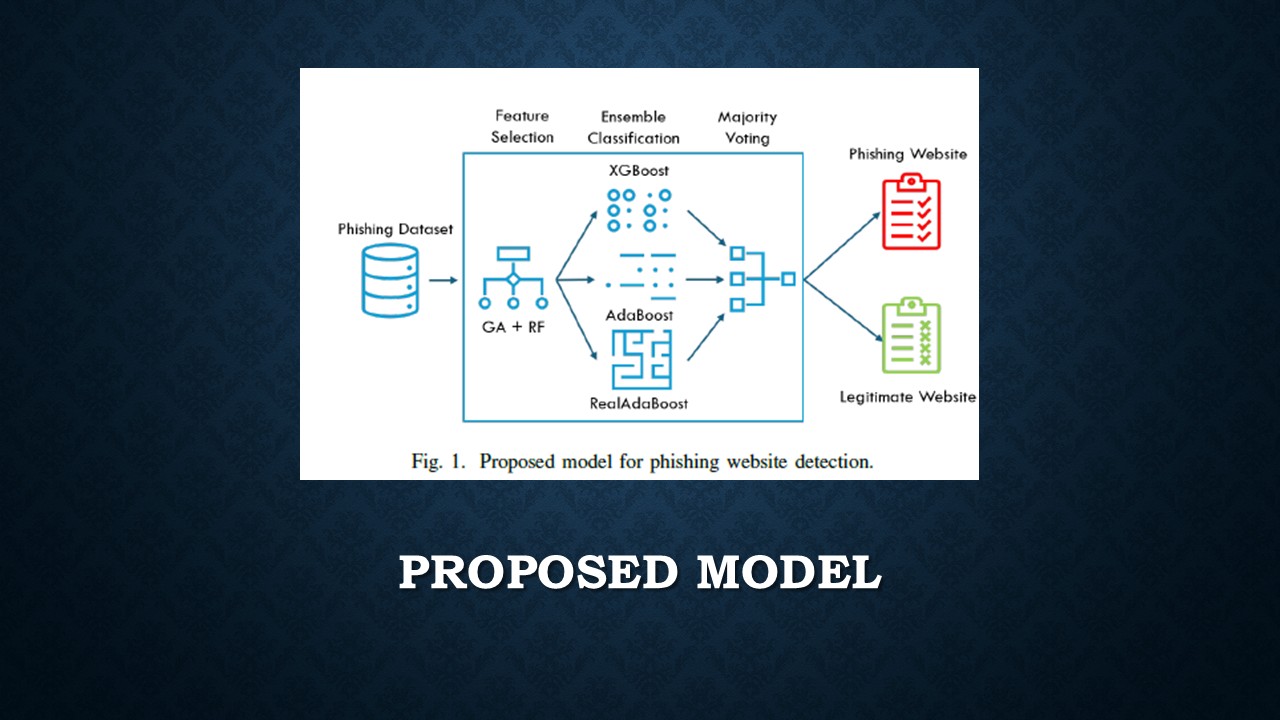
This figure illustrates the overall architecture of the proposed phishing detection model. The process begins with the phishing dataset, which is first passed through the feature selection stage. In this stage, a combination of Genetic Algorithm and Random Forest is used to identify and retain only the most relevant features for phishing detection.
The selected features are then forwarded to the ensemble classification stage, where three boosting-based models—XGBoost, AdaBoost, and Real AdaBoost—are used to perform classification from different learning perspectives. Each model independently generates prediction results based on the optimized feature set.
Finally, the predictions from all classifiers are combined using a majority voting mechanism. This ensures more stable and reliable final decisions. Based on the voting outcome, the system classifies the input as either a phishing website or a legitimate website, providing improved detection accuracy compared to single-model approaches. |
 IEEE/ICACT20260061 Slide.12
[Big Slide]