 |
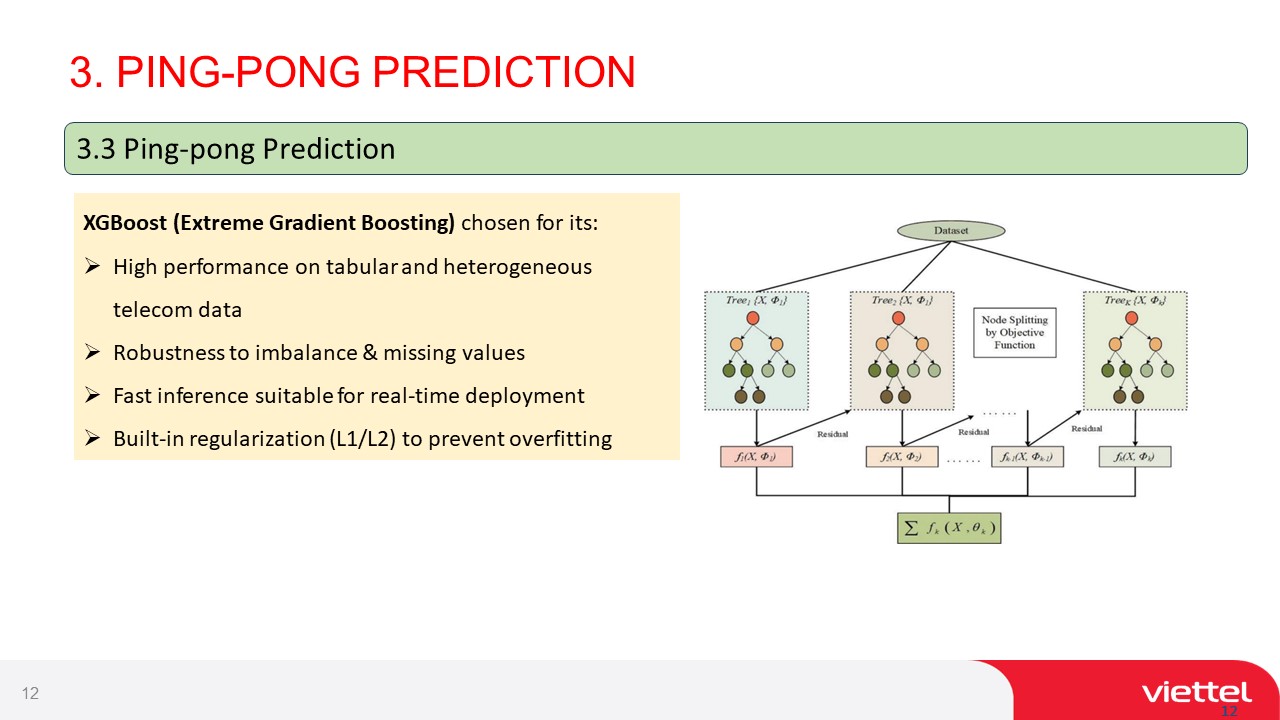
Slide 12 presents our chosen model for ping-pong prediction: XGBoost, or Extreme Gradient Boosting. We selected XGBoost for several key reasons:
First, it delivers high performance on tabular and heterogeneous telecom data. Our dataset includes a mix of numerical, categorical, and temporal features, which XGBoost handles effectively.
Second, XGBoost is robust to imbalance and missing values, common challenges in real-world data. It can learn from sparse datasets without extensive cleaning.
Third, the model enables fast inference, making it suitable for real-time deployment in the NWDAF. We need to generate predictions quickly as handover requests arrive.
Finally, XGBoost has built-in regularization with the L1/L2 parameters to prevent overfitting. This helps the model generalize well to new data.
The diagram illustrates the tree-based ensemble structure of XGBoost. The final prediction is the sum of outputs from a set of decision trees, each trained on the residuals of the previous trees. This gradient boosting approach allows the model to progressively refine its estimates and capture complex non-linear patterns.
With this robust and efficient prediction engine at the core of our NWDAF pipeline, we can provide timely intelligence to optimize handover decisions and mitigate ping-pong events proactively.
|
 IEEE/ICACT20260091 Slide.12
[Big Slide]